Oct 10, 2026Material Guides
PMMA Resin: 7 Checks Before You Order Acrylic Pellets
Learn how to choose PMMA resin for injection molding or extrusion. Compare flow, optical data, processing guidance, weathering information and batch documents before ordering.
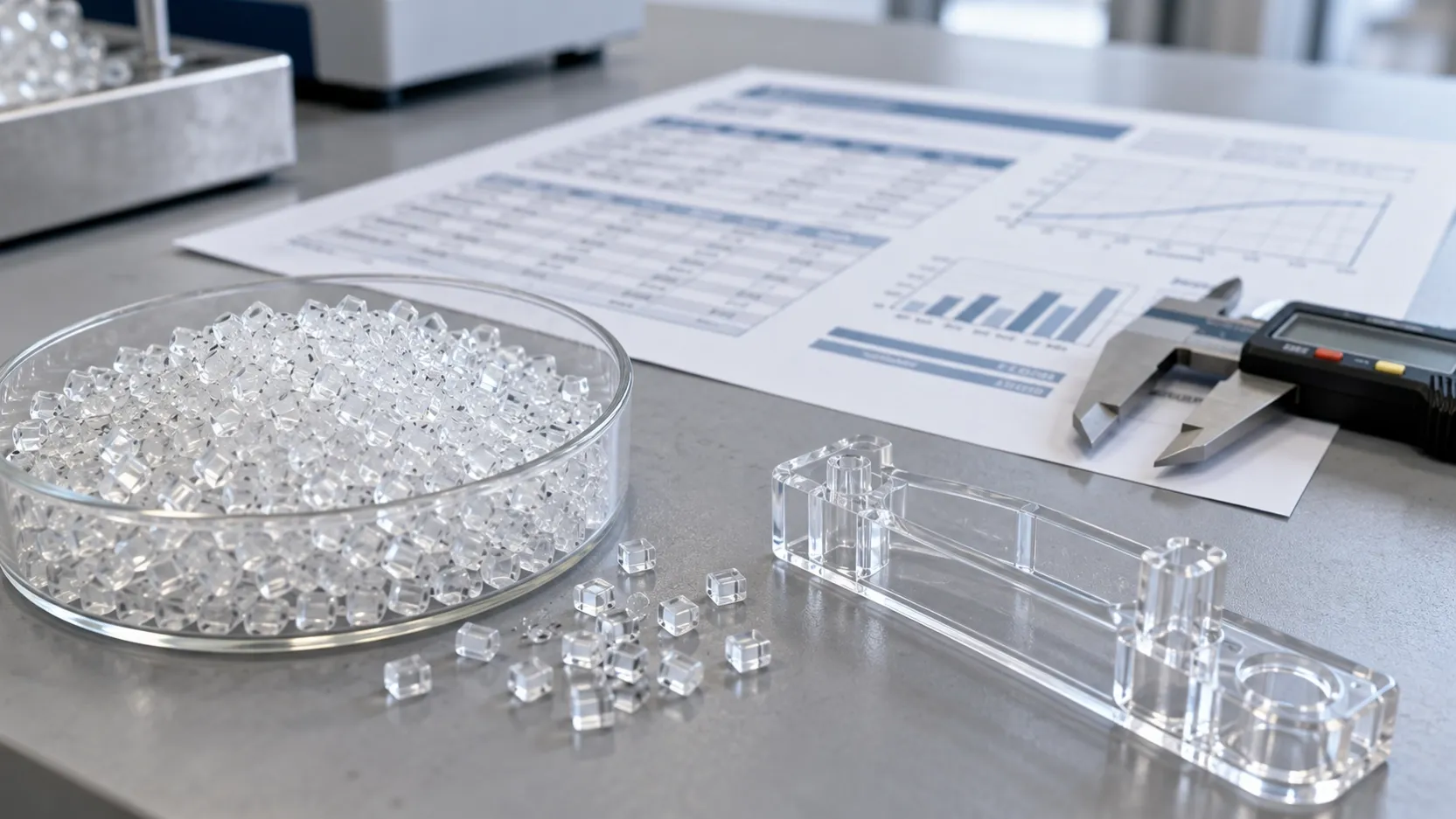
PMMA Resin Buying Guide: 7 Checks Before You Order Acrylic Pellets
A quotation that says “PMMA resin” is only the start of a specification.
Two acrylic pellet grades can look similar on paper but perform very differently in production. One may fill a thin-wall mold smoothly, while another may create flow marks, haze, color variation or unstable dimensions. The issue is not always that the resin is wrong; often, the purchasing specification is incomplete.
For buyers, molders and extrusion companies, the goal is simple: turn a generic PMMA quotation into a grade that can be processed, inspected and approved with confidence.
This guide explains the seven fields to check before ordering PMMA resin.
What Is PMMA Resin?
PMMA stands for polymethyl methacrylate. It is also commonly called acrylic or acrylic resin. PMMA is supplied as pellets for processing methods such as injection molding and extrusion.
It is frequently considered for clear or colored components where appearance, light transmission, surface quality and outdoor durability may matter. Typical applications include lighting components, display parts, transparent covers, profiles, cosmetic packaging and decorative molded products.
However, PMMA is not one universal material grade. Different grades can be developed for different flow behavior, optical performance, impact modification, weathering needs, color systems and processing methods.
That is why a purchase order should specify more than “transparent PMMA.”
Start with the Part and Process
Before comparing prices, define how the material will be used.
Ask these questions first:
- Is the part injection molded, extruded or thermoformed?
- Is the product clear, translucent, colored or opaque?
- Does the part need to diffuse light or remain optically clear?
- Will it be used indoors or outdoors?
- Is surface appearance more important than impact performance?
- Does the mold have thin walls, long flow lengths or visible gate areas?
- Does the component have tight dimensional requirements?
These answers determine which PMMA data matters most.
For example, a clear injection-molded cover and an extruded lighting profile may both use PMMA, but they should not automatically use the same grade.
The 7 PMMA Resin Fields to Check Before Ordering
1. Full Grade Identification
“PMMA” is a resin family, not a complete purchasing specification.
Always request:
- Full grade name
- Manufacturer name
- Color designation
- Current technical data sheet revision
- Intended processing method
- Any modification, such as impact-modified, weatherable or scratch-resistant formulation
This prevents a common sourcing problem: comparing two quotations that use the same generic material name but refer to different grade designs.
A complete grade identity is especially important when switching suppliers or approving an alternative source.
2. Melt Flow Data and Test Conditions
Flow behavior affects how PMMA fills the mold or moves through an extrusion die.
A flow value by itself is not enough. Ask whether the data is reported as:
- Melt flow rate (MFR)
- Melt volume rate (MVR)
- Test standard
- Test temperature
- Test load
Without test conditions, flow figures from two suppliers cannot be compared fairly.
In general, processing requirements influence the preferred flow range:
- Injection molding often requires sufficient flow to fill the mold consistently.
- Extrusion applications may place more emphasis on melt stability and surface quality.
- Thin-wall or long-flow parts may need a different balance than thick optical parts.
Do not approve a grade based on a flow number alone. Use the value to screen materials, then confirm behavior through a production trial.
3. Optical Performance at the Correct Thickness
For transparent PMMA parts, appearance depends on more than light transmission.
A proper optical comparison should include:
- Light transmittance
- Haze
- Yellowness index or color data
- Test method
- Specimen thickness
A clear material can show high light transmission but still appear milky if haze is too high. Likewise, a low initial yellowness value does not guarantee long-term appearance if the material is processed incorrectly or used in a demanding environment.
Thickness matters. Optical data measured on a thin test plaque should not be used directly to predict a thick molded component, diffuser or profile.
When the final part is appearance-critical, request data measured at a thickness close to the real product.
4. Color and Long-Term Appearance Requirements
For visible PMMA products, color control should be written into the purchase requirement.
Depending on the application, ask for:
- Natural, transparent or specified color grade
- Color tolerance method
- Yellow index or color coordinates
- Sample plaque or molded sample
- Weathering information for outdoor use
- Surface quality expectations after molding or extrusion
This is particularly important for lighting parts, transparent housings, signage components and multi-part assemblies. A small color difference may be more noticeable when two clear panels are placed next to each other.
If the product will be exposed to sunlight, ask the supplier what test method, exposure conditions and post-test measurements support any weathering statement.
5. Mechanical and Heat Performance
PMMA is often selected for appearance, but the final part must still survive handling, assembly and service conditions.
Review the data relevant to your design, such as:
- Tensile strength and tensile modulus
- Impact performance
- Heat deflection temperature
- Vicat softening temperature
- Dimensional stability
- Stress-cracking resistance for the expected environment
The most useful values are those tested under conditions close to the real application.
For example:
- A display cover may require scratch resistance and cosmetic quality.
- A lighting component may require stable appearance at elevated temperature.
- A snap-fit part may need sufficient toughness during assembly.
- A large sheet or profile may require dimensional consistency after processing.
Do not use a single tensile-strength figure as the entire selection basis.
6. Drying and Processing Guidance
Processing errors can make a suitable PMMA grade look like a poor material.
Moisture, excessive barrel temperature, long residence time and unsuitable regrind control can affect surface quality and color. Common visible defects may include silver streaks, haze, discoloration, flow marks or inconsistent gloss.
Before the first production run, request the supplier’s guidance for:
- Drying temperature and drying time
- Recommended moisture control
- Barrel temperature profile
- Mold temperature range
- Residence-time limits
- Regrind recommendation
- Shrinkage range
- Start-up and purge recommendations
Do not copy settings from another polymer or another PMMA grade without checking the current processing guide.
A controlled trial is more useful than assumptions based on a previous material.
7. Batch Documents and Change Control
Technical data sheets describe a grade. A certificate of analysis helps identify the material delivered in a specific shipment.
For each important order, confirm:
- Lot number
- Manufacturing date
- COA availability
- Key release values, where supplied
- Packaging condition
- Storage requirements
- Change-notification process
- Sample approval procedure for a new lot or alternative source
For appearance-critical or export projects, establish an agreed process before the first commercial order. This reduces disputes if a future batch behaves differently from the approved sample.
PMMA Sourcing Checklist
Field | What to Request | Why It Matters |
|---|---|---|
Grade identity | Full grade, manufacturer and color designation | “PMMA” alone does not identify a process-ready material |
Flow behavior | MFR or MVR with temperature, load and method | Allows a meaningful comparison between grades |
Optical data | Transmittance, haze and color data with thickness | Determines visible clarity and consistency |
Mechanical data | Tensile, impact and heat values with methods | Connects the resin to the part’s service requirements |
Processing guide | Drying, temperature, shrinkage and regrind guidance | Helps prevent avoidable molding or extrusion defects |
Batch documents | COA, lot number and packaging information | Supports traceability for delivered material |
Change control | Alternative-source and sample-approval process | Reduces risk when a supplier or lot changes |
A Simple PMMA Approval Process
A practical approval process does not need to be complicated.
Step 1: Review Documents
Compare the technical data sheet, processing guide and quotation. Confirm that all figures use stated test methods and conditions.
Step 2: Run a Controlled Trial
Use a documented set of processing conditions. Record surface appearance, dimensions, cycle stability, scrap rate and color consistency.
Step 3: Evaluate the Final Part
Inspect the real component, not only a standard test plaque. Check fit, appearance, clarity, assembly performance and any relevant service condition.
Step 4: Approve the Lot and Control Changes
Retain the approved sample, document the grade and lot, and define what must be reviewed before a future material change.
Common PMMA Purchasing Mistakes
Avoid these frequent mistakes:
- Comparing melt-flow values with no test conditions
- Ordering “clear PMMA” without optical requirements
- Using a sheet-grade specification for an injection-molded part
- Ignoring drying and residence-time recommendations
- Treating a new supplier’s grade as a drop-in replacement
- Approving resin from pellet appearance alone
- Relying on an outdoor-performance statement without test details
- Using unverified application or certification claims in the purchase specification
Choose a Grade, Not Just a Resin Name
The best PMMA resin is not simply the clearest or the lowest-priced option. It is the grade that matches your processing method, appearance target, part design and service environment.
Before placing an order, confirm the seven fields in this guide. Doing so helps reduce trial costs, cosmetic rejects and unnecessary supplier changes.
Need help reviewing a PMMA technical data sheet or preparing a resin inquiry? Send us your part application, process method, target color or optical requirement, and annual volume. We can help identify the key information needed before a production trial.