Oct 10, 2026Material Guides
POM Homopolymer vs Copolymer: How to Choose the Right Acetal Grade
Compare POM homopolymer and copolymer for gears, clips, valves and precision molded parts. Learn how stiffness, chemicals, shrinkage and processing affect grade selection.
POM Homopolymer vs Copolymer: How to Choose the Right Acetal Grade
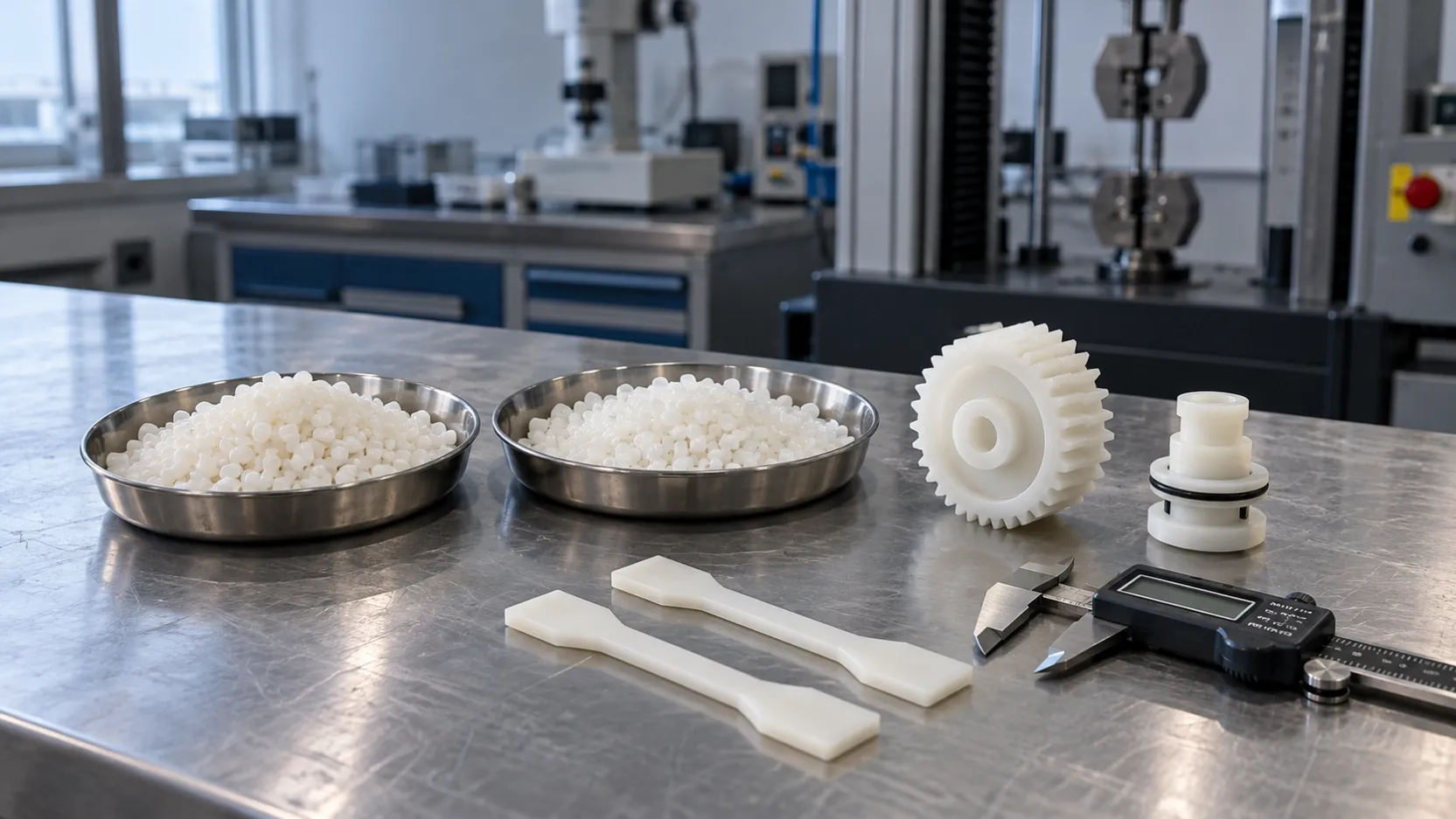
POM, also called acetal or polyacetal, is widely used for precision molded components such as gears, clips, bearings, valve parts, housings and wear components. However, “POM” alone is not enough information for a purchasing or engineering decision.
The first question should be: does the application need POM homopolymer or POM copolymer?
Both material families offer low friction, good machinability and useful mechanical performance. But their behavior can differ when a part is exposed to continuous load, tight dimensional requirements, chemicals, hot water, repeated assembly or long production cycles.
This guide helps buyers, molders and product engineers compare POM-H and POM-C before approving a grade.
POM-H and POM-C: Know the Difference Before Comparing Quotes
POM is a polymer family. The most common commercial forms are:
- POM Homopolymer (POM-H): Often selected where higher stiffness, strength retention and creep resistance are important.
- POM Copolymer (POM-C): Often considered for applications involving moisture, chemicals, hot water exposure or a broader molding process window.
A quote that simply says “POM natural” or “acetal resin” does not tell you which material family you are buying. Before comparing prices, ask the supplier for:
- Full grade name and manufacturer
- POM-H or POM-C designation
- Technical data sheet
- Melt flow or viscosity data
- Shrinkage data
- Recommended molding conditions
- Lot-specific COA where required
Two materials may both be described as POM, but they should not automatically be treated as drop-in replacements.
Quick Decision Guide: Which POM Should You Evaluate First?
Application Requirement | Material Family to Evaluate First | What to Verify |
|---|---|---|
Constant-load gears, bushings or structural components | POM-H | Creep, fatigue, dimensional stability and long-term load performance |
Parts exposed to moisture, hot water or cleaning chemicals | POM-C | Resistance to the actual chemical, temperature and exposure time |
Snap fits, clips and repeated assembly parts | Both | Deflection, fatigue resistance and assembly force |
Tight-tolerance molded components | Depends on the full grade | Shrinkage, post-molding stabilization and assembly dimensions |
Existing tools switching to a new supplier | Depends on validation results | Actual molded-part dimensions, warpage and cycle stability |
Wear or sliding components | Both | Friction, wear rate, mating surface and lubrication conditions |
This table is a starting point—not a final specification. The best choice always depends on the exact grade and service environment.
1. Stiffness and Creep: Important for Parts Under Continuous Load
POM homopolymer is commonly associated with higher crystallinity, which can make it an attractive candidate for rigid components carrying a continuous load.
For example, a small gear, latch, actuator component or loaded bracket may gradually deform if the material does not maintain its shape over time. For these applications, buyers should look beyond a single tensile-strength number.
Request and compare:
- Tensile strength and tensile modulus
- Flexural strength and flexural modulus
- Creep data at the actual service temperature
- Fatigue performance, where the part cycles repeatedly
- Heat deflection temperature under the stated test load
- Part geometry and stress concentration points
A material with a higher short-term strength value is not automatically better. The useful question is whether the molded part still performs after the expected load, temperature and service duration.
2. Moisture, Chemicals and Hot-Water Exposure
POM copolymer is often evaluated for components exposed to humid conditions, water, cleaning agents or certain chemical environments.
Typical examples include:
- Valve and fluid-handling components
- Pump parts
- Appliance components exposed to moisture
- Industrial parts cleaned with chemical solutions
- Plumbing-related assemblies
- Components used in humid production environments
However, “chemical resistance” is never a universal claim. A grade may perform differently depending on:
- Chemical type
- Concentration
- Temperature
- Internal stress in the molded part
- Exposure duration
- Whether the part is under load
Before approving a material, provide the supplier with the real operating medium. “Chemical resistant” is not enough information for an engineering decision.
3. Shrinkage Can Change Tool Fit and Assembly Performance
Changing from one POM grade to another may affect part dimensions even when the mold, machine and nominal material type remain the same.
This matters especially for:
- Precision gears
- Press-fit components
- Bearing seats
- Mating housings
- Valve assemblies
- Multi-component products with tight tolerances
Do not approve a replacement material based only on pellet data. Measure the actual molded parts after they have stabilized.
A practical validation check should include:
- Mold a controlled trial using the proposed grade.
- Measure the tightest dimensions after the agreed conditioning period.
- Assemble the part with its mating component.
- Test functional movement, load, noise and fit.
- Compare results with the current approved material.
The lowest resin price can become expensive if it causes assembly rejects, tool adjustments or customer complaints.
4. Processing Conditions Matter as Much as Resin Type
POM-H and POM-C may require different processing settings depending on the grade, color, additive package and melt-flow level.
Before switching, review:
- Drying recommendations
- Barrel temperature profile
- Mold temperature
- Injection speed and holding pressure
- Residence time
- Regrind policy
- Venting and gate design
- Cycle time and part appearance
Avoid using one generic molding recipe for every acetal grade. A stable process should be developed around the supplier’s recommended range and verified through production trials.
5. Can POM Copolymer Replace POM Homopolymer?
Sometimes, but not automatically.
A copolymer may be a reasonable candidate when the part’s environment has changed—for example, when moisture, hot water or chemical exposure has become more important than maximum stiffness.
But a material switch should be qualified when the part involves:
- Safety-related functions
- Customer-approved specifications
- Leakage prevention
- Structural load
- Tight-tolerance assemblies
- Long-term fatigue
- Tooling that cannot easily be modified
The question is not “Can POM-C replace POM-H?” The better question is:
“Can this exact proposed grade meet the functional requirements of this exact molded part?”
6. A Practical Three-Step Qualification Plan
Step 1: Confirm the Material Documentation
Collect the supplier’s TDS, COA format, grade designation, molding guide and any available application information.
Step 2: Run a Controlled Mold Trial
Use the same tooling and document the settings. Compare cycle stability, appearance, warpage, dimensions and scrap rate.
Step 3: Test the Real Part Function
Check the performance that matters to the end product: gear noise, clip retention, torque, leakage, wear, load retention or repeated-use durability.
This approach is more reliable than selecting a resin only by price, density or melt flow.
Frequently Asked Questions
Is POM the same as acetal?
POM, acetal and polyacetal are commonly used names for the same general polymer family. However, buyers should still confirm whether the quoted product is a homopolymer or copolymer grade.
Is POM-H always stronger than POM-C?
Not in every application. POM-H is often selected for stiffness and creep-related needs, but actual performance depends on the exact grade, test method, temperature, geometry and service environment.
Is POM-C better for chemical exposure?
POM-C is often evaluated for moist or chemically exposed applications, but suitability must be confirmed against the specific chemical, concentration, temperature and exposure time.
Can I switch POM suppliers without changing the mold?
Possibly, but a material switch can affect shrinkage, dimensions, warpage, cycle time and assembly fit. A molding trial is recommended before full production approval.
Choose by Part Function, Not by Material Name Alone
POM homopolymer and copolymer are both valuable engineering plastics, but they solve different design and processing priorities.
Start with the real part requirement:
- Choose a homopolymer candidate when stiffness, creep resistance and continuous-load performance are central.
- Evaluate a copolymer candidate when moisture, chemical exposure or process robustness is a major concern.
- Validate either option with the actual mold, actual part dimensions and real service conditions.
Need help sourcing POM-H or POM-C grades for a specific application? Send us your part drawing, processing method, operating environment and annual volume for a more targeted recommendation.