How to Qualify a Second Source for Engineering Resins Without Disrupting Molding Production
A practical qualification plan for adding a second source for PC, POM, ABS or PET resin without turning a supply-risk decision into a molding problem.
When resin availability tightens, the obvious response is to find another supplier. The harder part comes later: making sure the new material does not become the reason a stable molding line starts producing rejects.
That distinction matters most for engineering resins. A PC, POM, ABS or PET grade can look close on a quotation sheet and still behave differently in a real tool. A change in melt flow, moisture condition, shrinkage behaviour, pigment package or lot consistency may show up as short shots, flash, dimensions drifting out of tolerance, poor appearance or an unexpected change in cycle time.
The practical aim is not to prove that two grades are identical. It is to create enough evidence to approve a second source for a defined part, tool and process window.
Start with the part, not the resin name
“Same polymer family” is a useful starting point, not an approval decision. Before contacting a second source resin supplier, create a short baseline for the existing material:
- current manufacturer and grade;
- end-use and any regulatory or customer requirements;
- latest TDS, SDS and three recent COAs where available;
- molding machine, tool cavity, drying conditions and key process settings;
- the part features that actually drive quality: dimensions, surface appearance, impact resistance, sealing, optical clarity, friction or colour;
- reject rate and the defects the plant already watches.
This baseline prevents the project from becoming a comparison of two marketing descriptions. It gives purchasing and engineering one shared definition of acceptable.
Do not compare flow values without the test conditions
Melt flow is often the first number people compare. It is useful, but only when the test method, temperature and load are the same.
ASTM D1238 describes melt-flow testing for thermoplastics and notes that the result is affected by the measurement conditions and is not a fundamental material property. In other words, a flow value from one set of conditions is not automatically comparable with a value taken at another temperature or load.
For a concrete reference point, Covestro lists Makrolon® 2458 polycarbonate at a typical melt volume-flow rate of 19 cm³/10 min, with a stated range of 15–22.5 cm³/10 min, measured at 300 °C / 1.2 kg under ISO 1133-1. Those numbers are not a universal target for another PC grade; they illustrate why the test condition has to travel with the number.
For a second-source review, record the value, unit, method and test condition together. MFR 12 is incomplete. MVR 12 cm³/10 min, ISO 1133-1, 300 °C / 1.2 kg is usable.
A six-gate qualification plan
1. Check supply and traceability first
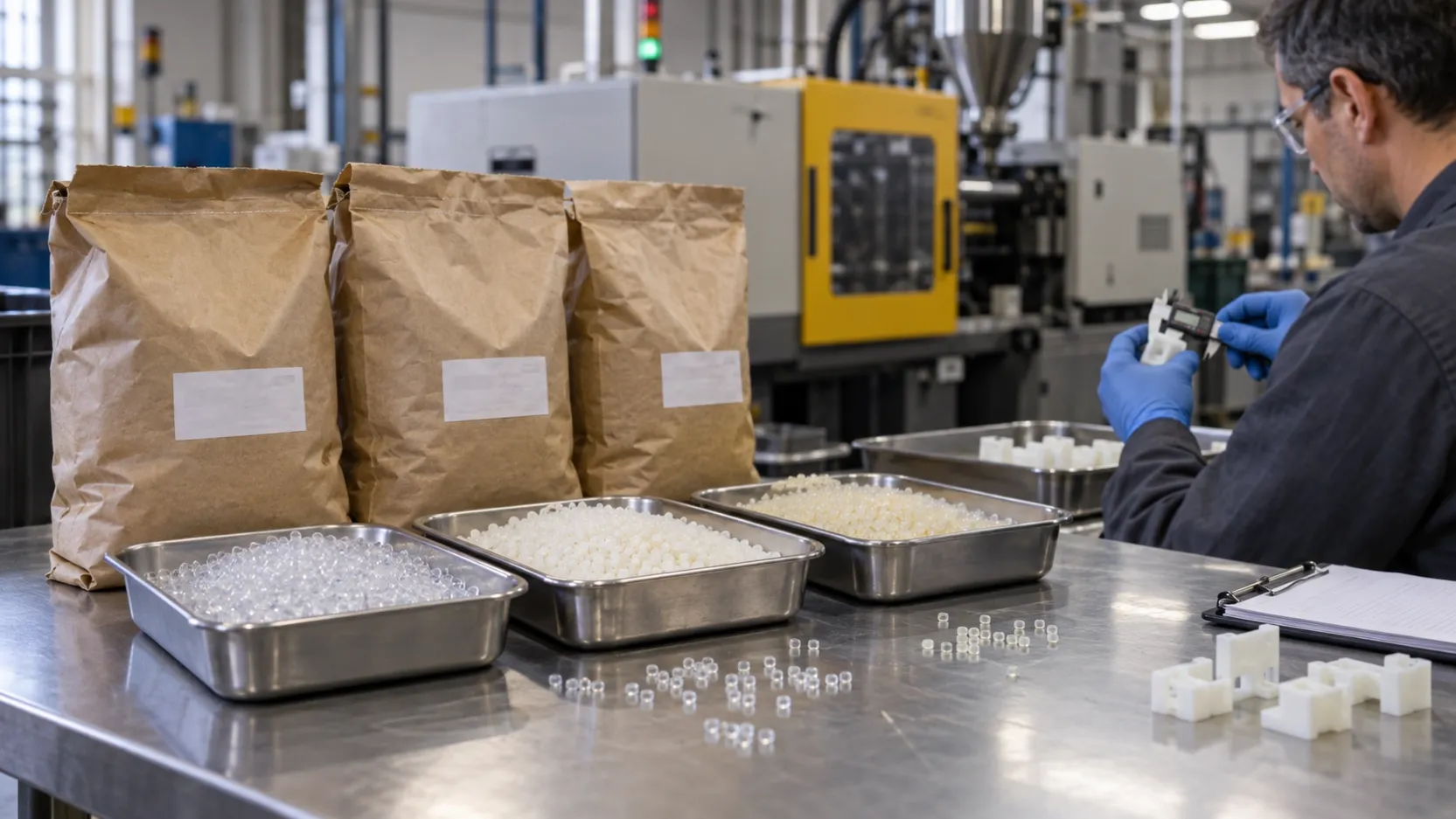
Ask for more than a price and a lead time. Request the grade name, manufacturing origin, packaging, typical lead time, minimum order quantity, TDS, SDS and a recent COA. Confirm how the lot number on the bag maps to the COA.
This is where a supplier can clarify what it can provide; it is not a promise that global supply conditions will never change. The objective is a documented alternative source and a repeatable way to identify each incoming lot.
2. Compare the data sheet line by line
- Polymer type and grade form: a homopolymer, copolymer, filled grade or flame-retardant grade may need a different approval route.
- Flow value and test condition: changes fill balance, pressure demand and shear sensitivity.
- Density: can affect shot-weight checks and part-weight expectations.
- Tensile and impact data: helps identify performance changes that a visual inspection will miss.
- Heat performance: important for parts exposed to heat during use or assembly.
- Drying and processing guidance: a different moisture limit or melt-temperature window can change the trial plan.
- Colour, additives and compliance status: often overlooked until a customer audit or approval issue appears.
Use like-for-like test conditions. If one supplier reports a value under ISO 527 and another under a different method, flag it for engineering review instead of treating the figures as interchangeable.
3. Define the first trial before material arrives
Do not wait until the bags are beside the machine to decide what success looks like. Set the comparison quantities in advance: a target part weight, the dimensions to measure, cosmetic checkpoints, mechanical tests where required and the number of parts needed for a meaningful review.
Keep the first trial controlled. Use the established tool and, where possible, start from the normal process window. Record any change made to barrel temperatures, drying, holding pressure, cooling or cycle time. If several settings change at once, the plant cannot tell whether the material or the adjustment solved the problem.
4. Inspect the part, not just the machine screen
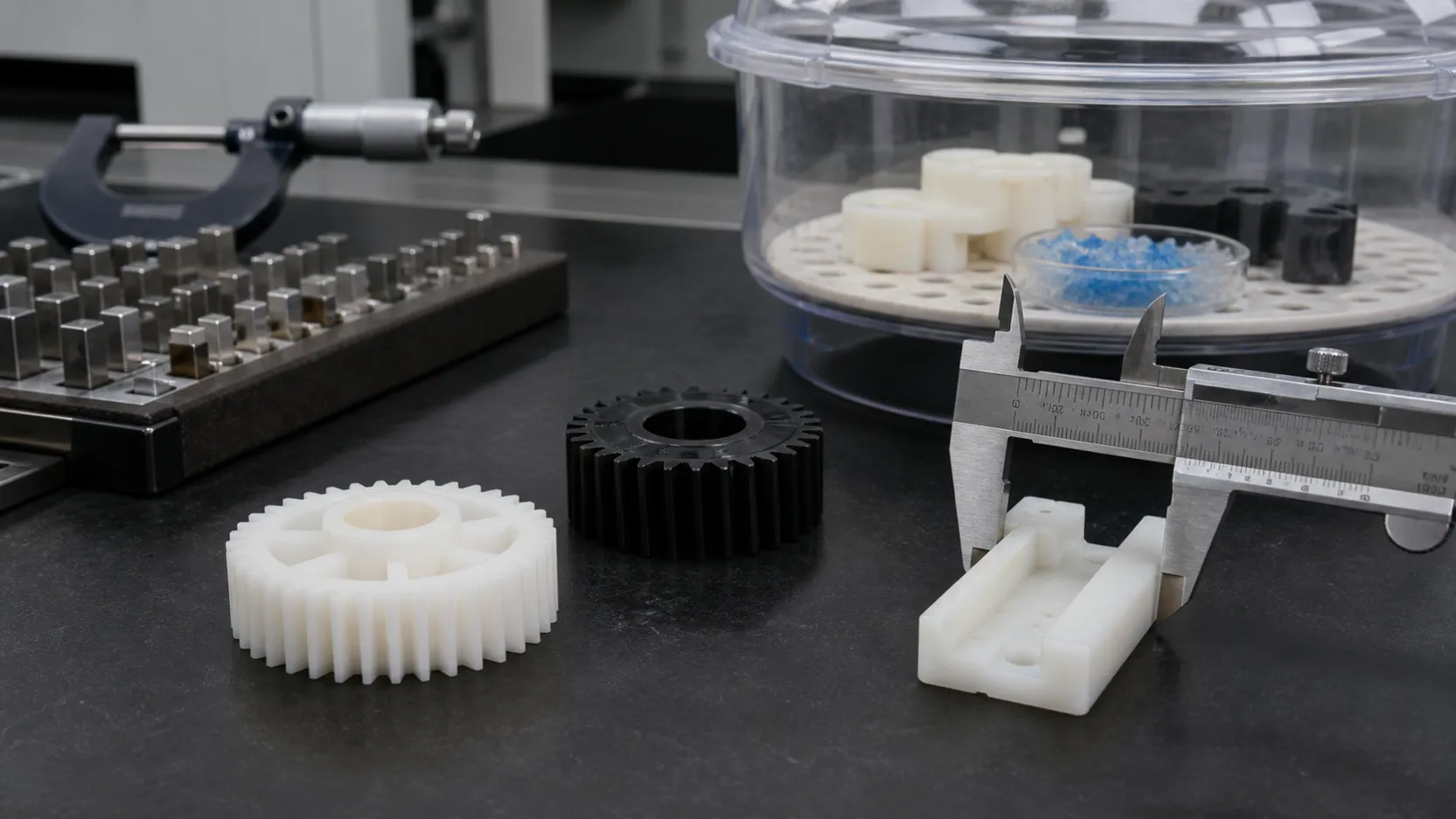
A candidate resin may fill the cavity and still fail the application. Compare the trial parts with approved production parts for critical dimensions after the same conditioning period; weight and cavity-to-cavity consistency; warpage, sink, weld lines, flash and short shots; surface gloss, haze, colour or black specks; and assembly fit, sealing, torque, friction or load performance as relevant to the part.
For a tight-tolerance POM component, dimensional stability and friction behaviour may be more important than a small change in cycle time. For a clear PC component, haze and stress cracking can be the deciding checks. The qualification plan should reflect the actual failure mode, not a generic material checklist.
5. Run a limited production pilot and review a second lot
One successful sample run does not prove lot-to-lot consistency. Where the part is commercially important, run a limited pilot and repeat the critical checks on a second incoming lot. Save the COA, process sheet and inspection record with the approval.
ASTM D1238 specifically positions flow-rate testing as useful for quality control and as an indicator of flow uniformity. It should not be used alone to prove that all other properties are unchanged. That is why the pilot must combine incoming documentation, process evidence and finished-part results.
6. Turn the result into change control
If the material passes, document exactly what has been approved: supplier, grade, permitted plant, part number, process notes, inspection plan and any customer approval needed before routine use. If it fails, document why. A failed candidate with a known limitation is still useful purchasing information.
The approval sheet that keeps purchasing and engineering aligned
A compact approval sheet is more valuable than a long email thread. Include the current and candidate grade; COA and bag-lot numbers; flow value, test method, temperature and load; drying requirement and actual trial moisture result if measured; process settings; part weight and dimensional checkpoints; appearance and functional results; approval scope; and sign-off by purchasing, process engineering and quality.
The numbers in this sheet should come from the plant’s own product requirements. Do not copy a tolerance from an unrelated resin or a web article.
Questions to ask a second source resin supplier
Before ordering a trial quantity, ask for the current TDS and a representative COA, then ask practical questions: Is the grade virgin material? Is the product available in the required colour or additive package? What information accompanies each lot? Can the supplier support a sample and keep the grade traceable after approval?
For PC, POM, ABS and PET projects, LeMa Plastic can be approached for current grade availability, TDS/COA documentation and a sample discussion. Final suitability should always be confirmed on the customer’s own tool and application.
A second source is a controlled option, not an emergency shortcut
Supply volatility is a reason to prepare alternatives early. It is not a reason to bypass material validation. The plants that handle supply interruptions best are usually not those with the longest supplier lists. They are the ones that already know which materials, documents and part tests are needed to approve a second source without losing control of production.