Sep 1, 2026Material Guides
POM vs Nylon for Precision Molded Parts: How to Avoid Dimensional Drift
POM vs nylon for gears, clips, and sliding parts: compare moisture absorption, stiffness change, wear, and processing to prevent dimensional drift.
POM vs Nylon for Precision Molded Parts: How to Avoid Dimensional Drift
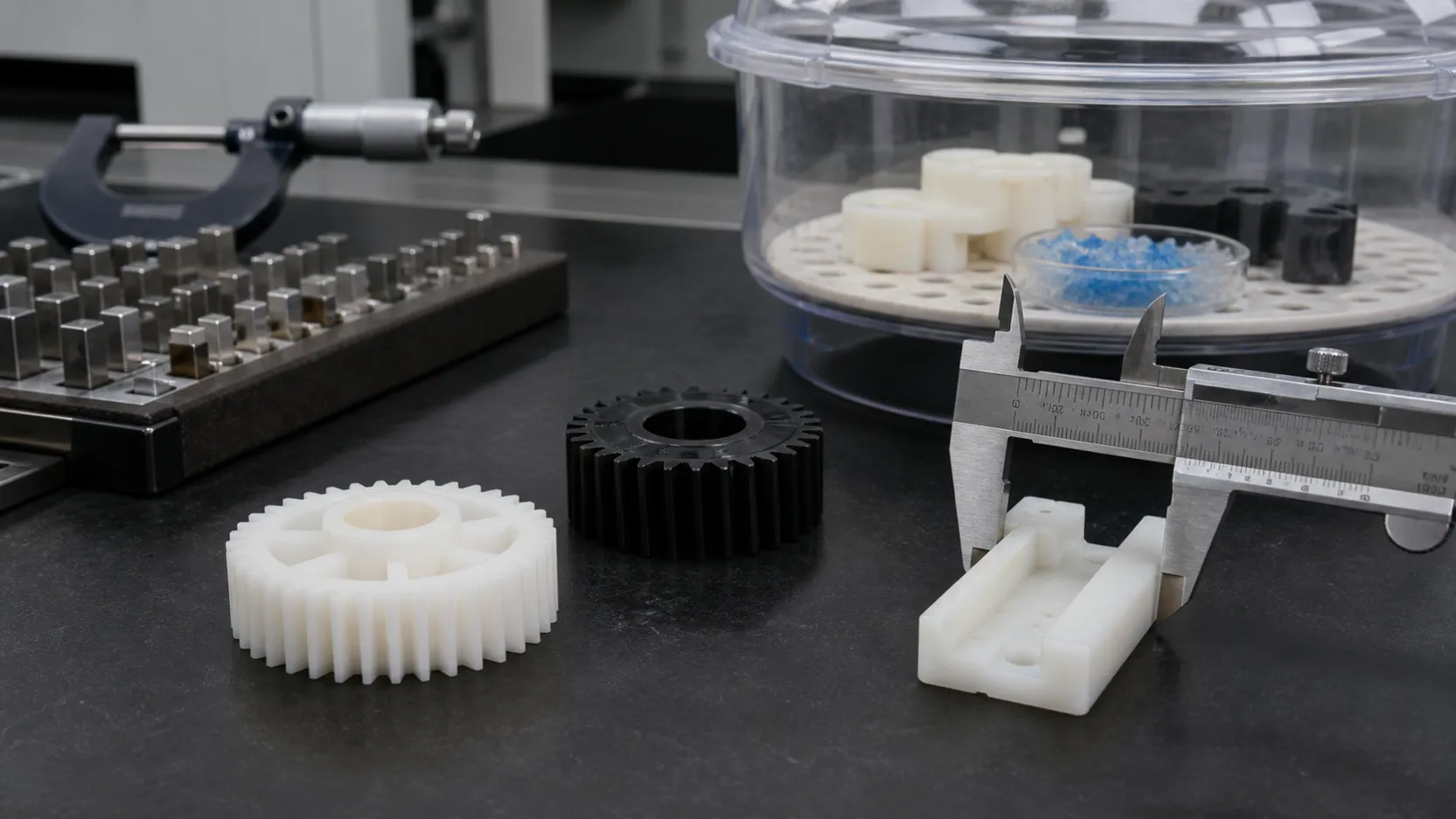
When a molded gear, latch, guide, or sliding component goes out of tolerance after shipment, the first reaction is often to blame the mold. Sometimes the mold is the issue. Just as often, the part is responding exactly as its polymer chemistry predicts.
That is the practical difference behind a POM vs nylon decision. Both are proven engineering plastics. Both can run well in injection molding. But they behave very differently when humidity, immersion, heat, friction, and long-term loading enter the picture.
For a precision part that must hold dimensions in a humid environment, POM (acetal) is often the better starting point. For parts that need toughness, temperature capability, or a reinforced structural solution, nylon (PA) may be the stronger route—provided the design team accounts for moisture conditioning and property change.
The short answer
Use POM as the first material to evaluate when the part is a close-tolerance gear, clip, valve component, sliding guide, or mechanism that must remain dimensionally predictable through normal humidity changes.
Use nylon when the part benefits from its broad grade range, toughness, reinforcement options, and performance in applications where moisture uptake has been designed into the tolerance and validation plan.
The right choice is not “POM is better than nylon.” It is “which material changes in a way the part can tolerate?”
1. Moisture is the biggest dividing line
Nylon absorbs moisture. That is not a defect; it is a material behavior that must be included in design, storage, assembly, and test conditions. As nylon conditions, dimensions and mechanical response can shift.
POM also absorbs moisture, but at a much lower level in many common unfilled grades. For context, Delrin® 100P lists 0.40% water absorption after 24 hours of immersion at 23°C and 1.5% at saturation under ASTM D570. In contrast, BASF’s Ultramid® B3K PA6 lists 9–10% water absorption at saturation in water at 23°C, measured similarly to ISO 62.
These are published typical values for two specific grades, using different test families. They should not be used as a direct purchase specification. They do show why a nylon part can need a more deliberate conditioning strategy than a POM part.
2. Why moisture becomes a tolerance problem
A precision component is rarely tested in a laboratory state and then used in that same state. It may be molded dry, packed in a humid warehouse, assembled in another climate, and installed in a wet or warm operating environment.
For nylon, that journey can affect:
- Hole diameter and center-to-center distance.
- Tooth engagement in gears.
- Snap-fit force and clip retention.
- Flatness in thin parts.
- Stiffness and creep response.
- Assembly force with metal inserts or mating plastics.
The effect is not simply “the part gets bigger.” Geometry, fiber orientation, wall thickness, gate location, and moisture gradient all matter. A part with a tight datum system can show a larger functional shift than a simple coupon would suggest.
3. Compare dry and conditioned properties before choosing nylon
Many material data sheets show dry and conditioned values for nylon. That is useful information, not an inconvenience to ignore.
For example, BASF lists a tensile modulus of 3,100 MPa dry and 1,000 MPa conditioned for Ultramid® B3K PA6 at 23°C under ISO 527. The same data sheet lists yield stress of 80 MPa dry and 40 MPa conditioned. Those numbers do not mean every nylon grade will behave the same way. They make one point clearly: if a nylon part will operate conditioned, the design should not be signed off on dry-coupon values alone.
With POM, verify the exact homopolymer or copolymer grade, additives, fillers, and service temperature. POM is not automatically the answer for every high-load or high-temperature component. But for many low-friction, close-tolerance mechanisms, its lower moisture response is a meaningful design advantage.
4. Friction and wear: define the actual contact condition
Buyers often choose POM for gears, slides, and latches because it is a strong candidate for low-friction mechanisms. A published Delrin® 100P value for dynamic coefficient of friction is 0.30 under ASTM D3702, with no lubricant. That value is useful only as a starting point.
Real wear behavior depends on more than the base resin:
- Mating material and surface finish.
- Contact pressure and sliding speed.
- Temperature rise at the contact point.
- Lubrication, contamination, and moisture.
- Geometry, alignment, and cycle count.
- Fillers, lubricants, and reinforcement in the selected grade.
Do not select a material for a gear train from a coefficient-of-friction line in a data sheet. Test the actual mating pair under the expected load and temperature. A good resin choice can still fail if the tooth geometry, alignment, or lubrication assumption is wrong.
5. Processing discipline matters for both materials
Moisture can affect processing as well as end-use behavior. Nylon must be handled and dried according to the grade supplier’s recommendation. BASF, for example, lists a maximum water content of 0.15% for one Ultramid® B3S processing guide before molding.
POM also needs controlled handling. For Delrin® 100P, one published processing guide recommends drying and lists a maximum processing moisture content below 0.2%. Excess moisture, excessive residence time, or a poor temperature window can leave you with visual defects, degradation, unstable dimensions, or inconsistent mechanical performance.
The practical rule is simple: do not compare a carefully dried POM trial with a nylon trial whose moisture state is unknown. Record moisture, dryer conditions, melt temperature, mold temperature, hold profile, and part weight for both.
6. A decision table for buyers and engineers
Requirement | Usually evaluate first | Why | Important caution |
|---|---|---|---|
Tight tolerance across changing humidity | POM | Lower moisture response in many standard grades | Confirm shrinkage, creep, and temperature for the exact grade |
High toughness after conditioning | Nylon | Conditioned nylon can be very tough | Validate dimensions and stiffness in the service moisture state |
Sliding mechanism or low-friction component | POM | Strong starting point for many gears, guides, and latches | Wear still depends on mating surface, pressure, and speed |
Glass-fiber structural part | Reinforced nylon | Large grade range and strong reinforced options | Fiber orientation and moisture can affect warpage and tolerance |
Under-hood or hot environment | Grade-dependent | Both families have specialized grades | Use real temperature, chemical, and aging tests—not a family-level assumption |
7. Build a validation plan before the first production order
For a precision molded part, ask the supplier and molder to agree on a short validation plan:
- Define the service condition. State humidity, immersion, temperature range, chemicals, load, and cycle count.
- Set the conditioning state. Measure critical dimensions as molded, after a controlled humidity condition, and after the relevant immersion or aging exposure.
- Use the same test language. ASTM D570 and ISO 62 both address water absorption, but methods and specimens can differ. Record the exact method and condition.
- Measure functional dimensions. Check tooth backlash, insertion force, sealing surface, snap retention, or sliding force—not only a length coupon.
- Request lot traceability. Keep the grade name, supplier documentation, processing record, and retained samples linked to the approval.
That plan turns “POM or nylon?” from a materials debate into a controlled engineering decision.
POM vs nylon: the practical conclusion
If humidity-related dimensional change is the risk you cannot accept, start with POM. If you need nylon’s toughness, reinforcement options, or application-specific grades, specify the material around its conditioned state rather than its dry data-sheet headline.
LeMa Plastic can help buyers source virgin POM resin, review the grade request against the molding process, and prepare the documentation needed for a controlled material evaluation.
FAQ
Is POM more dimensionally stable than nylon?
For many common unfilled grades in humid conditions, POM has a lower moisture response than nylon and is therefore often easier to manage for close-tolerance parts. Exact stability still depends on grade, geometry, molding conditions, temperature, and load.
Can nylon be used for precision parts?
Yes. Nylon is widely used in precision components, but the tolerance strategy should account for its moisture-conditioned state. Validate critical dimensions and function after the exposure the part will actually see.
Is POM always better for gears?
No. POM is a strong candidate for many low-friction gears, but nylon may be preferred when impact, temperature, reinforcement, noise, or application-specific performance is more important. Test the real gear pair and duty cycle.
Technical data note
The numerical examples are typical published values for named commercial grades and stated test conditions. They are not specification limits and should not replace qualification of the final part. Confirm the current TDS for the offered grade and test under the expected service conditions.