Aug 22, 2026Material Guides
Crystallinity in BOPET, BOPP and CPP Films: A Business Guide
Crystallinity influences the performance, processability and application range of flexible films. This guide explains its role in BOPET, BOPP and CPP films and how to select the right material balance
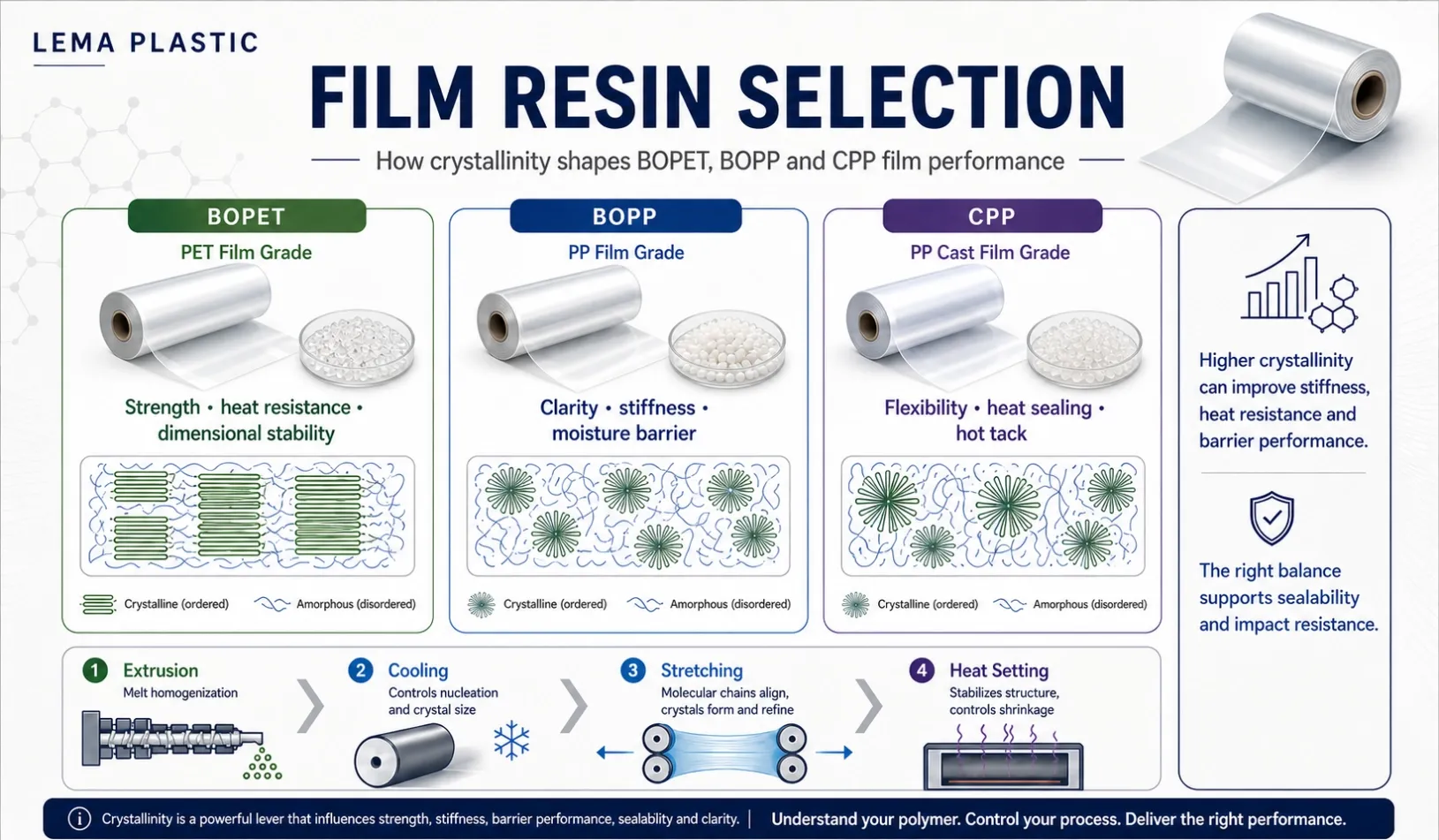
Plastic resin selection is one of the most important decisions in film production and flexible packaging. The resin affects extrusion stability, film thickness uniformity, mechanical strength, clarity, barrier performance, heat sealing and overall production cost.
For packaging buyers, procurement managers and technical teams, resin selection is not simply a matter of choosing PP or PET. Different grades of the same polymer can have significantly different molecular weight, melt strength, crystallization behavior, additive systems and processing requirements.
The right resin should match the film process, the intended packaging structure and the final performance target.
Why Resin Selection Matters to Film Production
A suitable film-grade resin can improve:
- Extrusion stability
- Melt strength
- Film thickness uniformity
- Stretching performance
- Mechanical strength
- Clarity and gloss
- Heat resistance
- Heat-sealing performance
- Barrier properties
- Production efficiency
An unsuitable resin may lead to:
- Unstable extrusion
- Thickness variation
- Breakage during stretching
- Poor film appearance
- Excessive haze
- Weak seals
- Low hot-tack performance
- Poor lamination results
- Higher scrap rates
- Increased production costs
The objective is not to select the resin with the highest individual performance in one area. The objective is to select a resin that provides a balanced and stable result under actual production conditions.
PP and PET Resins: Different Materials, Different Applications
PP Resin
Polypropylene resin is widely used in flexible packaging because it offers a useful balance of processability, stiffness, moisture resistance and cost efficiency.
PP resin is commonly used to produce:
- BOPP film
- CPP film
- Cast sheets
- Packaging films
- Labels
- Laminated packaging structures
Different PP grades are designed for different processes. BOPP production requires resin with suitable stretching behavior and orientation performance. CPP production requires stable melt strength, good casting behavior and reliable sealing performance.
PET Resin
PET resin is commonly used for polyester film and packaging applications requiring high strength, dimensional stability and heat resistance.
PET film is often selected for:
- Outer packaging layers
- Printing substrates
- Lamination structures
- High-strength packaging
- Electrical and industrial films
- Applications requiring stable dimensions during converting
PET resin quality can affect drying requirements, melt stability, film appearance, stretching behavior and final mechanical performance.
BOPP, BOPET and CPP: Matching Resin to Film Process
BOPP Film
BOPP is produced by stretching polypropylene film in the machine direction and transverse direction. The resin must support stable extrusion and controlled biaxial orientation.
Important resin considerations include:
- Melt flow behavior
- Molecular weight and distribution
- Stretching stability
- Clarity and gloss
- Stiffness
- Moisture resistance
- Surface treatment compatibility
BOPP is commonly used for snack packaging, labels, overwrap and laminated structures.
BOPET Film
BOPET is produced by biaxially stretching polyester film. It is valued for strength, dimensional stability, heat resistance and printing performance.
Important PET resin considerations include:
- Intrinsic viscosity
- Moisture control
- Melt stability
- Stretching performance
- Film clarity
- Heat resistance
- Surface and lamination compatibility
BOPET is often used as an outer or structural layer in flexible packaging.
CPP Film
CPP is produced by casting molten polypropylene onto a chill roll. Compared with BOPP, CPP generally provides greater flexibility and better heat-sealing performance.
Important CPP resin considerations include:
- Melt strength
- Casting stability
- Seal initiation temperature
- Seal strength
- Hot-tack performance
- Flexibility
- Impact resistance
- Compatibility with multilayer structures
CPP is frequently used as the inner sealing layer in flexible packaging.
Key Resin Properties Buyers Should Evaluate
Melt Flow and Processability
Melt flow behavior affects extrusion pressure, output stability and film formation. A resin with unsuitable flow characteristics may cause unstable production or poor thickness control.
The correct melt-flow range depends on:
- Extruder design
- Screw configuration
- Film process
- Line speed
- Film thickness
- Required output
Molecular Weight and Melt Strength
Molecular weight influences mechanical performance and melt strength. Higher molecular weight may improve strength and melt stability, but it can also increase processing difficulty.
Molecular-weight distribution affects how the resin flows and stretches. A suitable distribution can support stable extrusion, uniform orientation and efficient production.
Crystallization Behavior
Crystallization affects film clarity, stiffness, shrinkage, heat resistance and dimensional stability. Cooling rate, stretching temperature and heat-setting conditions can all change the final film structure.
Resin selection should therefore be evaluated together with the intended cooling and stretching process.
Additives and Surface Performance
Additives may be used to improve:
- Slip
- Antiblocking
- Processing stability
- Heat resistance
- Surface energy
- Printability
- Sealing performance
However, additives can also affect haze, coefficient of friction, sealing behavior, lamination and recycling considerations. The additive system should match the final application.
Selecting Resin for Multilayer Flexible Packaging
A multilayer package normally assigns different functions to different layers.
A typical structure may include:
- BOPET or BOPP as the outer or structural layer
- Adhesive or tie layer for bonding
- CPP or another sealant film as the inner layer
The outer layer may need to provide:
- Strength
- Stiffness
- Printability
- Gloss
- Dimensional stability
- Protection during handling
The inner layer may need to provide:
- Low seal initiation temperature
- High seal strength
- Good hot-tack performance
- Reliable sealing through contamination
- Flexibility and impact resistance
The best resin choice depends on the complete structure rather than the performance of one film layer alone.
A Practical Resin Selection Framework
Before approving a resin, buyers and manufacturers should confirm:
- Whether the resin is designed for the intended film process.
- Whether melt flow and melt strength match the extrusion equipment.
- Whether the resin supports the required film thickness and line speed.
- Whether stretching stability is sufficient for BOPP or BOPET production.
- Whether clarity, haze and gloss meet the packaging requirements.
- Whether mechanical properties are suitable for filling, transportation and storage.
- Whether the sealing layer provides the required seal window and hot-tack performance.
- Whether the resin is compatible with printing, coating and lamination.
- Whether quality remains consistent between production batches.
- Whether the total material cost is acceptable after considering scrap and processing efficiency.
Laboratory data should be combined with production trials. A resin that performs well in a test report may still require process adjustments on the actual film line.
Talk to LEMA PLASTIC About Plastic Film Resins
LEMA PLASTIC supports packaging manufacturers, film producers and converters in evaluating PP, PET and other plastic resins for film applications.
Our team can help assess resin options according to:
- Film production process
- Extrusion equipment
- BOPP, BOPET or CPP requirements
- Multilayer packaging structure
- Mechanical and sealing targets
- Printing and lamination needs
- Production efficiency and cost objectives
Contact LEMA PLASTIC to discuss your application, review suitable film-grade resin options or identify materials for PP, PET and other flexible packaging products.