Sep 24, 2026Material Guides
PC Resin for LED Diffusers: How to Specify Haze, Transmittance and UV Stability
Buying PC resin for LED diffusers? Use this practical checklist to specify light transmission, haze, UV stability, melt flow, documents and trial requirements before ordering.
PC Resin for LED Diffusers: How to Specify Haze, Transmittance and UV Stability
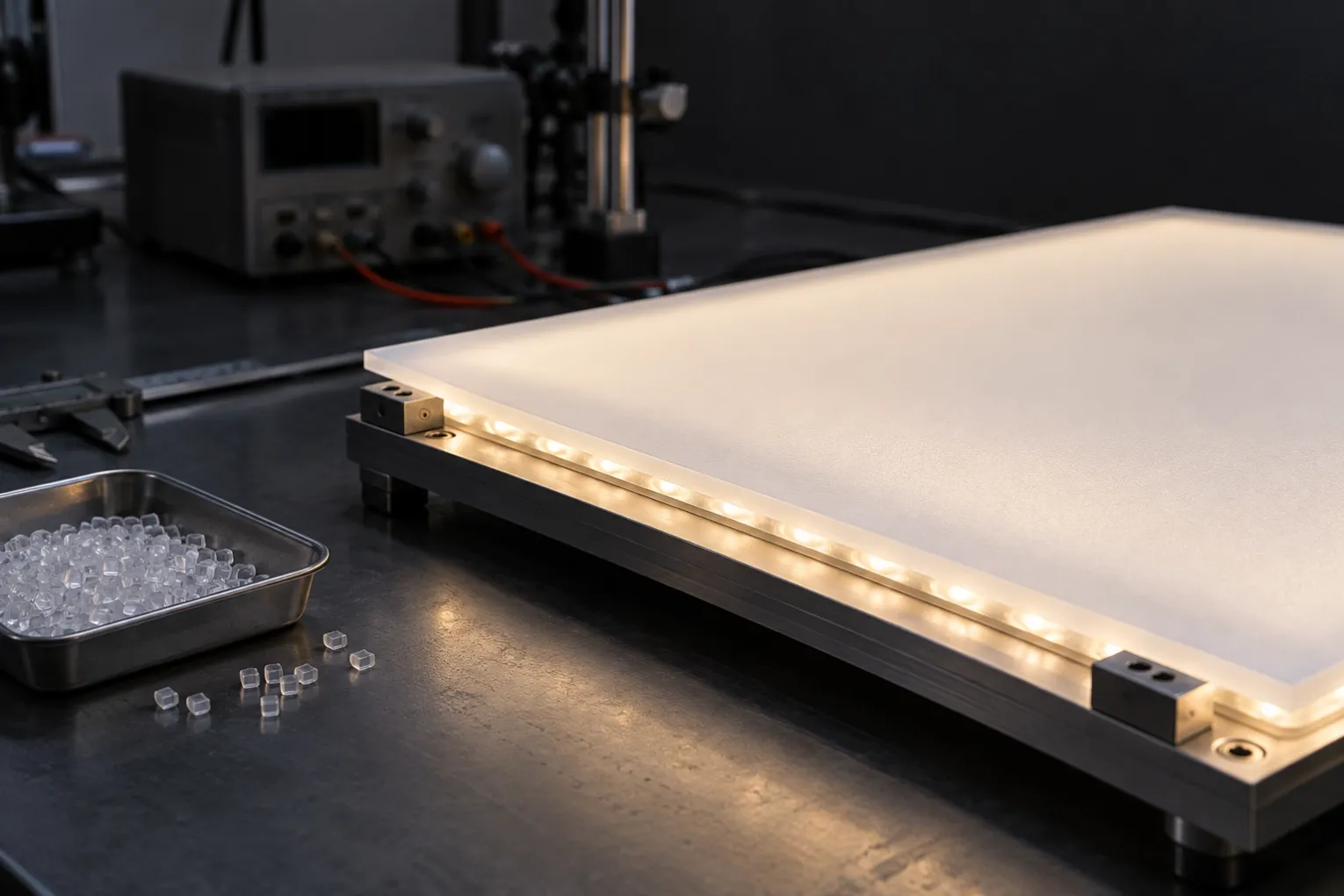
An LED diffuser is often described as a simple translucent plastic part. In production, it is rarely simple. A diffuser that looks acceptable under one light source can reveal LED points, show uneven brightness or yellow after installation. Buyers then discover that asking for “clear PC” was not enough of a specification.
For lighting producers and sheet converters, the useful question is not which resin has the highest headline clarity. It is whether the proposed polycarbonate (PC) grade, additive package and process can deliver the required appearance on the finished diffuser.
This guide gives procurement and technical teams a practical way to brief suppliers before requesting a PC resin quotation.
Begin with the lighting application
The same PC resin will not necessarily suit every lighting part. State what you are making before you ask for a grade:
- LED diffuser sheet, extrusion profile, lens, lamp cover or injection-molded housing;
- indoor, covered outdoor or fully exposed outdoor use;
- linear LEDs, point LEDs or a surface light source;
- extrusion, injection molding, thermoforming or a secondary fabrication process;
- target part thickness and surface finish.
Thickness and LED spacing have a major effect on the final visual result. A resin cannot compensate for an optical design with LEDs too close to the diffuser surface. Conversely, a suitable material can still underperform if drying, temperature control or die conditions introduce stress and flow marks.
Transmittance and haze should be specified together
Buyers often focus only on light transmission. High transmission can be valuable, but it is not the only objective for a diffuser.
Transmittance describes how much visible light passes through a sample. Haze describes how much the transmitted light is scattered. In a diffuser project, the balance between the two affects both brightness and the ability to hide individual LED points.
A part with very high transmission and insufficient diffusion may make the LEDs visible. A heavily diffusing part may produce a smooth appearance but reduce output more than the lighting design allows. The acceptable balance depends on the part thickness, surface texture, pigment or diffuser additive, LED pitch and customer approval standard.
Instead of requesting a generic “milky PC,” send the supplier a finished-part sample or specify the target visual outcome: point-source hiding, uniform brightness, color appearance and acceptable light loss. Ask how the reported optical values were measured, including specimen thickness and test method. Optical figures from a thin molded plaque should not be assumed to describe a thick extruded diffuser.
Do not overlook UV and heat exposure
For outdoor luminaires, façade lighting and signage, the resin has to manage more than optics on day one. UV exposure, temperature cycling and cleaning chemicals can change color and surface appearance over time.
Ask whether the proposed grade contains UV stabilization and whether the supplier has weathering guidance for the intended use. A UV-stabilized PC grade may be appropriate for many outdoor transparent or translucent parts, but the finished part still needs validation under its real exposure conditions. Colorants, coatings, wall thickness, installation angle and local climate all influence the result.
Heat also deserves attention. An enclosed luminaire can run much warmer than the surrounding room. Provide the expected operating temperature, maximum part temperature if known, and the expected service life. This lets a supplier avoid proposing a grade based only on room-temperature impact performance.
Melt flow is a processing decision, not a catalogue detail
Melt flow rate (MFR) helps a processor understand how a grade may behave in the selected route. It should be discussed with the part design and equipment, rather than used alone to select a resin.
For example, LeMa Plastic lists Wanhua CLARNATE® OL1058 as a UV-resistant PC resin with a stated MFR of 6 g/10 min, measured at 300°C/1.2 kg, and a reported light-transmission reference of 88%. Those values are useful comparison points for a transparent-PC conversation. They do not establish a diffuser specification by themselves: the final haze, color and light distribution will depend on the finished-part design and the chosen diffuser solution.
When reviewing a PC quote, ask for the current TDS and verify the stated test conditions. MFR figures measured under different temperatures or loads should not be compared as though they are identical.
The document and trial checklist
Before you issue a purchase order or commit to a production trial, request:
- The current technical data sheet for the exact grade and color.
- A representative certificate of analysis (COA), and confirmation that the shipped lot will have its own COA and lot identification.
- SDS and any customer, lighting-market or destination-market documentation required for the project.
- Processing guidance, especially drying and temperature recommendations for the selected process.
- Packaging, moisture protection, pallet configuration, MOQ, lead-time basis and Incoterm.
- A retained resin sample and a finished-part approval plan.
For a lighting project, define the trial criteria before material arrives. This may include visual uniformity under the actual LEDs, transmission and haze checks at the agreed thickness, color comparison, impact needs, dimensional fit and a heat or UV exposure check where relevant. That is more reliable than approving a resin based on a natural-pellet photograph or a single data-sheet value.
Five common buying mistakes
1. Ordering “transparent PC” for a diffuser
Transparent PC can be a starting material, but it does not automatically diffuse light. The optical requirement needs to be described separately.
2. Comparing optical figures at different thicknesses
Ask how each figure was tested. Thickness, surface finish and additives can materially change the comparison.
3. Ignoring drying and handling
PC absorbs moisture. Inadequate drying can contribute to visible defects and unstable processing. The resin supplier can provide a starting guide, but the processor must validate conditions on its own equipment.
4. Treating UV resistance as an all-purpose outdoor guarantee
UV stabilization is one part of a finished-part durability plan. Confirm the intended exposure, part construction and validation method.
5. Approving the grade before testing it under the real light source
Use the final LED pitch, drive condition and diffuser geometry during approval whenever possible. A bench sample can be misleading.
A better enquiry for diffuser-grade PC
Include these points in your request: part type; conversion process; thickness range; indoor or outdoor environment; LED pitch and distance to diffuser; desired light transmission and diffusion effect; color target; UV and heat requirements; required documentation; estimated volume; destination and requested delivery term.
This brief gives suppliers enough context to propose a meaningful grade or to identify where a diffuser compound, masterbatch, coating or part trial is needed.
Buy the optical result, not only the resin name
PC remains a practical material for lighting components because it can combine impact performance, heat capability and useful optical properties. The purchase decision should still be made around the finished diffuser: its light uniformity, color, process stability and service environment.
LeMa Plastic can discuss virgin PC options, current TDS and COA documentation, and export details for lighting applications. For a diffuser project, send the part process, thickness and visual target so the proposed grade can be evaluated against the job rather than against a generic material label.
FAQ
Which PC resin is best for LED diffuser sheets?
The best option depends on the required light diffusion, transmission, thickness, LED spacing, process and service environment. Start with a material brief and test the proposed grade on the actual diffuser geometry.
Does a higher light-transmission value always make a better diffuser?
No. A diffuser needs the right balance between light output and the ability to hide LED points. Transmission should be reviewed with haze, thickness and the finished lighting design.
What information should I send when requesting PC resin for lighting?
Include the part type, process, thickness, LED layout, indoor or outdoor exposure, desired optical result, color, documentation requirements, estimated volume and destination.