Sep 24, 2026Material Guides
PET Resin IV Explained: How Bottle and Sheet Buyers Choose the Right Grade
Understand PET resin IV before you buy. Learn what intrinsic viscosity means, which documents to request, and how bottle and sheet buyers can avoid a wrong-grade order.
PET Resin IV Explained: How Bottle and Sheet Buyers Choose the Right Grade
When a buyer asks for PET resin, the first question is often, “What IV do you need?” It is a useful question, but not a complete specification.
Intrinsic viscosity (IV) is an important indicator related to PET molecular size and melt behavior. It helps a buyer narrow the field, especially for bottle, preform, sheet, strapping and fibre applications. But IV alone does not tell you whether a grade will give the required clarity, process stability, taste performance, color or finished-part result.
The safer approach is to use IV as the starting point for a defined application brief. This guide explains what PET buyers should ask before requesting a quotation or approving a trial lot.
What does PET resin IV mean?
Intrinsic viscosity is commonly reported in dL/g for PET. In practical buying conversations, it is used as one indicator of the resin’s molecular characteristics. It can influence melt processing and the balance of properties needed for a given conversion route.
It is tempting to treat a higher or lower IV as automatically better. It is not. The useful question is whether the grade’s IV range suits the product, process and quality target.
A bottle preform producer, for example, may prioritize a stable preform and the needs of the final container. A sheet producer may evaluate melt behavior, clarity, thickness control and the downstream thermoforming route. A strapping processor will have a different set of priorities again. The right PET grade is therefore application-specific.
Start with the final product, not the number
Before asking suppliers for a PET offer, write down the answers to five questions:
- What will the resin become: water bottle, beverage bottle, food container, sheet, strapping, film or fibre?
- What process will be used: preform injection, injection stretch blow molding, sheet extrusion, thermoforming or another route?
- Which finished-product checks matter most: clarity, color, top load, thickness distribution, taste, sealing, recycled-content strategy or production speed?
- Which destination-market documents are required?
- What are the expected order quantity, packaging preference and delivery point?
This brief gives the supplier something concrete to match. It also helps the buyer avoid receiving a quote for a nominally similar PET grade that was developed for a different process.
A real example: what a 0.80 IV bottle grade description tells you
LeMa Plastic’s listed Wankai WK-801 is described as a 0.80 IV water-bottle grade. Its published reference specification states an intrinsic-viscosity range of 0.80 ± 0.015 dL/g, acetaldehyde content of no more than 1.0 µg/g, and an L-value of at least 83. The product page also lists a 160–180°C, 4–6 hour drying range as a typical starting point.
Those numbers are useful for a buyer because they describe a starting profile: a bottle-oriented grade, an IV range, a low-acetaldehyde reference and color information. They are not a universal purchase specification for all PET applications, and they are not a substitute for the current manufacturer TDS and batch COA.
In particular, do not copy the 0.80 IV reference into an enquiry for sheet, strapping or another application without confirming that it fits the actual process. A resin supplier should be able to discuss the intended end use and provide an appropriate current grade reference.
Why acetaldehyde deserves a place in the discussion
For taste-sensitive water and food-packaging applications, acetaldehyde is not a detail to leave until the end of a purchase decision. The permitted level and the practical importance of the result depend on the application, design, processing conditions and customer requirements.
Ask the supplier what its TDS reports, whether a representative COA is available and how the lot documentation is tied to the shipped material. Then make sure process engineering reviews drying, residence time and melt conditions. A resin number on a COA and a finished package result are related, but they are not the same test.
The document set to request before a PET trial
A workable PET resin enquiry should request more than a price. Ask for:
- the current TDS for the proposed grade;
- a representative COA and an explanation of how the final lot COA will be supplied;
- SDS/MSDS and any destination-market compliance documentation required for the application;
- manufacturing origin and grade identification;
- packaging size, palletization and moisture-protection details;
- usual MOQ, lead-time basis and available Incoterms;
- the supplier’s current drying and processing guidance.
The TDS tells you the supplier’s stated typical properties. The lot COA provides the reported results for the shipment. Keep both with the receiving and trial records, along with bag or pallet lot numbers.
Bottle, sheet and strapping: do not use one approval route for all three
Bottle and preform projects
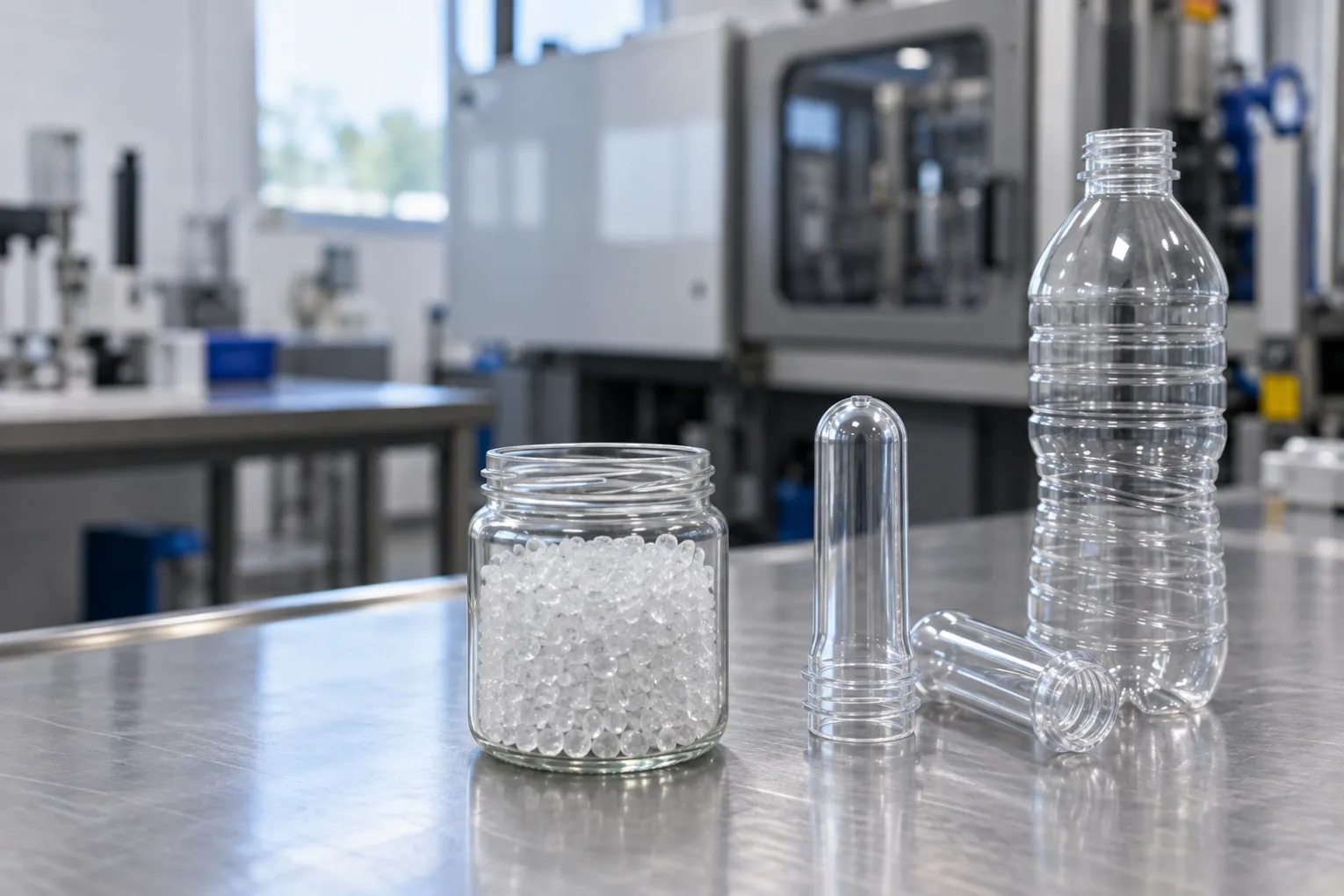
For bottle-grade PET, the discussion often includes IV, acetaldehyde, color, clarity, preform processing and the final container’s performance. A trial should examine the parts that the customer actually approves—not only whether the preform can be molded.
Sheet and thermoforming projects
For sheet, ask early about the desired sheet appearance, thickness consistency, thermoforming behavior, food-contact needs and the process equipment. A grade accepted for a bottle application should not be assumed suitable for a particular sheet line without a trial.
Strapping and other industrial applications
Strapping and industrial PET uses may emphasize tensile behavior, processing stability and the product’s service condition. The buyer should share the relevant conversion route and performance checks rather than relying on a single IV request.
Drying is part of material selection
PET absorbs moisture and must be dried before melt processing. If the resin is processed with excessive moisture, hydrolysis can reduce molecular weight and affect performance and appearance. That is why a quote review should include the supplier’s drying guidance, but the processor must still validate the dryer dew point, residence time, material handling and settings on its own equipment.
For WK-801, LeMa’s product page lists 160–180°C for 4–6 hours as typical guidance. Treat this as a starting reference, not a universal recipe. Process conditions should be verified against the current TDS, machine setup and product design.
Four mistakes that cause avoidable PET buying problems
1. Ordering by IV only
IV narrows the field; it does not define every processing or finished-product requirement.
2. Using an old data sheet to approve a new lot
Always request the current TDS and the applicable lot COA. Record the lot number received.
3. Ignoring the destination market until after shipment
If food-contact or customer-specific documentation is needed, state this in the enquiry and confirm it before the purchase order.
4. Treating drying as a supplier-only responsibility
The supplier can provide guidance. The processor remains responsible for validating the actual drying and conversion conditions.
A better PET enquiry template
To receive a useful quotation, provide: PET application; process; target IV or a current grade reference; key quality checks; color/clarity requirement; destination market; required documents; monthly or annual quantity; packaging preference; requested Incoterm; and delivery point.
This tells the supplier whether to propose a water-bottle grade, a different bottle grade, a sheet-oriented option or a grade requiring further technical review. It also gives procurement and production a shared record of what was requested.
Buy a grade that matches the job
PET resin IV is an important selection input, but it works best when paired with the end use, current technical documents and a controlled trial. The goal is not to find the most impressive number. It is to buy a documented PET grade that can be processed consistently into the product you need.
LeMa Plastic can support PET enquiries with grade discussion, current availability and TDS/COA documentation. For Wankai WK-801 and other PET requests, final suitability should be confirmed on the buyer’s own process and application.
FAQ
Is 0.80 IV PET resin suitable for every bottle project?
No. A 0.80 IV bottle grade can be a relevant starting point for many water-bottle projects, but the final decision should account for container design, processing route, quality requirements and the current grade documentation.
What should I request with a PET resin quotation?
Request the exact grade, current TDS, representative COA, packaging details, MOQ, lead-time basis, Incoterm and required compliance documents. Also state the end product, process, destination and expected quantity.
Is PET IV enough to choose a resin grade?
No. IV helps narrow the selection, but color, acetaldehyde where relevant, processing guidance, documentation and a controlled trial are also important.