Oct 9, 2026Material Guides
EVA vs POE: Which Flexible Resin Is Better for Foaming, Compounding and Impact Modification?
Compare EVA and POE for flexible compounds, foaming and impact modification. Learn what buyers should check before selecting an elastomer resin grade.
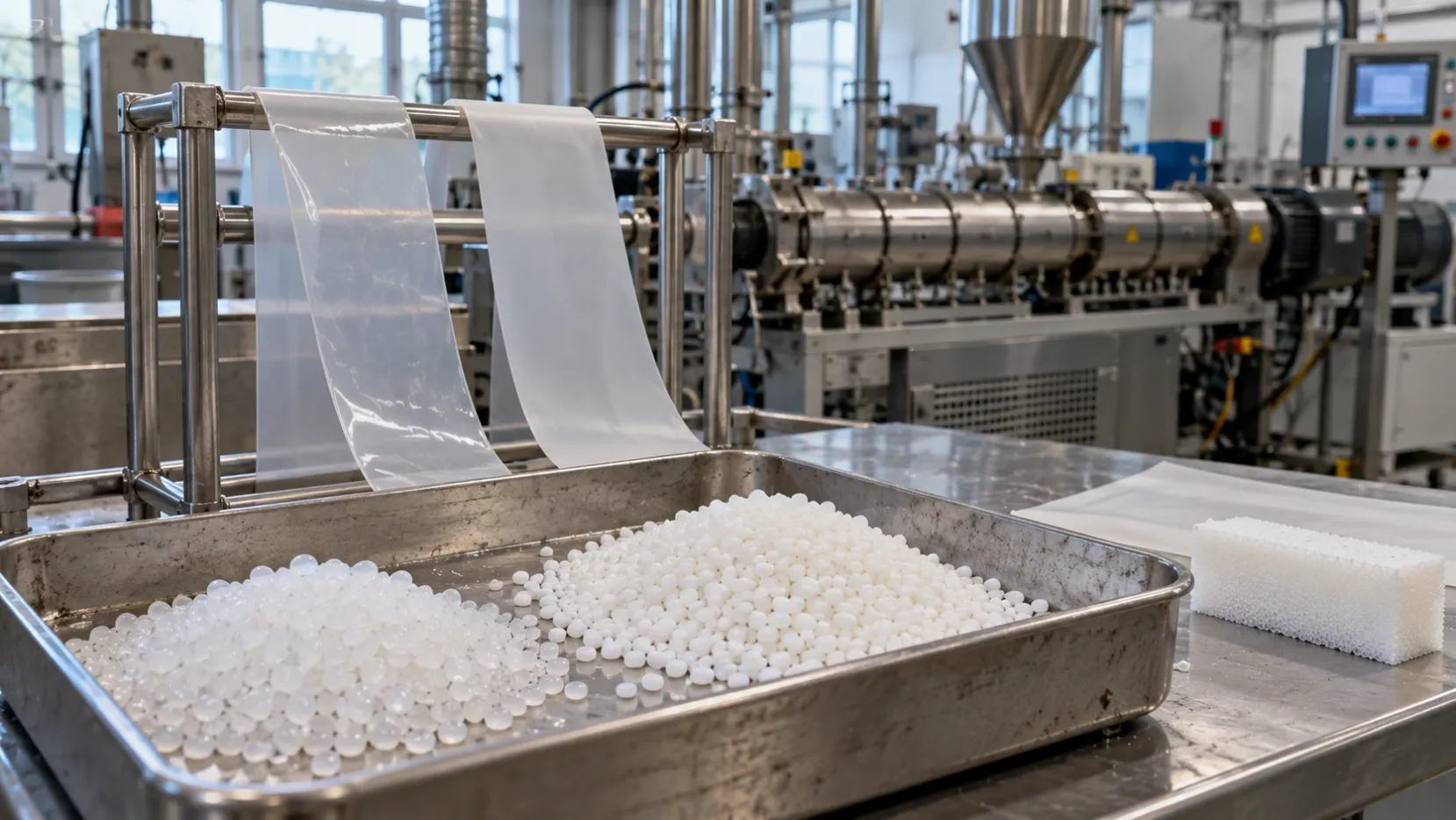
EVA and POE are both flexible polymer materials, but they are chosen for different reasons. Buyers often compare them when developing foamed products, flexible compounds, modified plastics or soft-touch components.
The question is not simply which resin is softer. The better question is: what balance of flexibility, processability, compatibility and finished-product performance does your project require?
The Quick Answer
Evaluate EVA when your project focuses on EVA-based foaming, flexible compounds, films, adhesives or modified formulations.
Evaluate POE when impact modification, elastomeric flexibility, low-temperature performance or soft-touch compound design is the main direction.
Selection should always be based on the actual grade, comonomer content, melt flow, formulation, processing conditions and target performance.
EVA: A Common Starting Point for Flexible Formulations
EVA is widely evaluated in flexible applications because the material can be supplied in different grades with different flow and vinyl-acetate-content profiles.
Typical evaluation areas include:
- Foaming compounds
- Flexible films
- Adhesive and hot-melt formulations
- Wire and cable compounds
- Modified plastics and soft products
When comparing EVA grades, buyers should review melt flow, vinyl acetate content, density, gel level, colour and compatibility with the full formulation.
POE: A Common Choice for Toughness and Flexibility Modification
POE is often evaluated as an elastomeric modifier in compounds and blends.
Typical evaluation areas include:
- Impact modification
- Flexible consumer-product components
- Soft-touch compounds
- Automotive and industrial compounds
- Modified polypropylene or engineering-plastic systems
POE selection should consider the base resin, target impact level, stiffness loss, dispersion quality and processing equipment.
EVA vs POE: A Practical Comparison
Decision Factor | EVA | POE |
|---|---|---|
Foaming and flexible compounds | Often evaluated first | May be used in selected compound designs |
Impact modification | Depends on formulation | Common evaluation direction |
Adhesive or film projects | Common evaluation direction | Grade and formulation dependent |
Soft-touch compounds | Can be considered | Often evaluated for elastomeric feel |
Key purchasing data | Melt flow, VA content, density | Melt flow, density, base-resin compatibility |
Final decision | Validate complete formulation | Validate complete formulation |
Four Mistakes Buyers Should Avoid
1. Comparing Only Melt Flow
Melt flow is important, but it does not define flexibility, compatibility or finished-product performance on its own.
2. Ignoring the Base Resin
An elastomer modifier must be compatible with the material being modified. Share the complete formulation direction with your supplier.
3. Ordering Before a Trial
A pilot trial is essential for foaming, compounding and impact-modification projects. Confirm dispersion, appearance, hardness, impact performance and processing stability.
4. Treating All EVA or POE Grades as Equivalent
Different grades can have materially different processing and performance behavior. Request the exact grade, current TDS, COA and recommended application information.
Final Takeaway
EVA and POE should be selected by application goal, not product name alone. EVA may be a strong starting point for flexible and foaming formulations, while POE is often evaluated for elastomeric flexibility and impact modification. The right choice comes from a documented formulation review and production trial.
Request an EVA or POE Material Review
Lema Plastic can help buyers compare EVA and POE grades for foaming, compounding and modified-plastic applications. Share your base resin, target property, process, destination market and expected volume for a practical sourcing recommendation.