Aug 25, 2026Material Guides
How to Tell If Plastic Resin Is Virgin or Recycled
Worried your supplier sold you recycled resin instead of virgin? Learn practical checks — from TDS reading to material testing — to verify resin quality before it disrupts production.
When a resin shipment does not match its documentation, the cost is rarely limited to the purchase price. It can show up later as unstable processing, inconsistent parts, rejected lots, and a difficult supplier discussion. The goal is not to rely on a single quick check; it is to build a repeatable acceptance process before a full production run.
If you buy PET, PC, POM, EVA, PMMA, or ABS resin, this buyer-focused guide explains what to request, what to inspect, and when to involve an independent laboratory.
Start With the TDS — But Don't Stop There
Every legitimate virgin resin shipment should come with a Technical Data Sheet (TDS) and Certificate of Analysis (COA). The TDS tells you what the material should perform like. The COA tells you what this specific batch actually tested at.
Here is what to check:
• Batch number consistency: Does the lot number on the COA match the lot number printed on the bags? A mismatch is a red flag — it means the COA wasn't generated from this batch, or worse, was copied from a different shipment entirely.
• Melt Flow Index (MFI): Compare the result, test method, and test condition on the COA with the manufacturer's TDS for the exact grade. A result outside the stated specification deserves clarification before production.
• Ash content and contaminants: Request the actual test results and the applicable specification. Unexpected inorganic residue can indicate filler, contamination, or a material that does not match the agreed grade.
A COA that only lists "pass/fail" without actual numerical values is not a COA — it's a marketing document. Insist on numbers.
Visual Inspection: Pellets Don't Lie
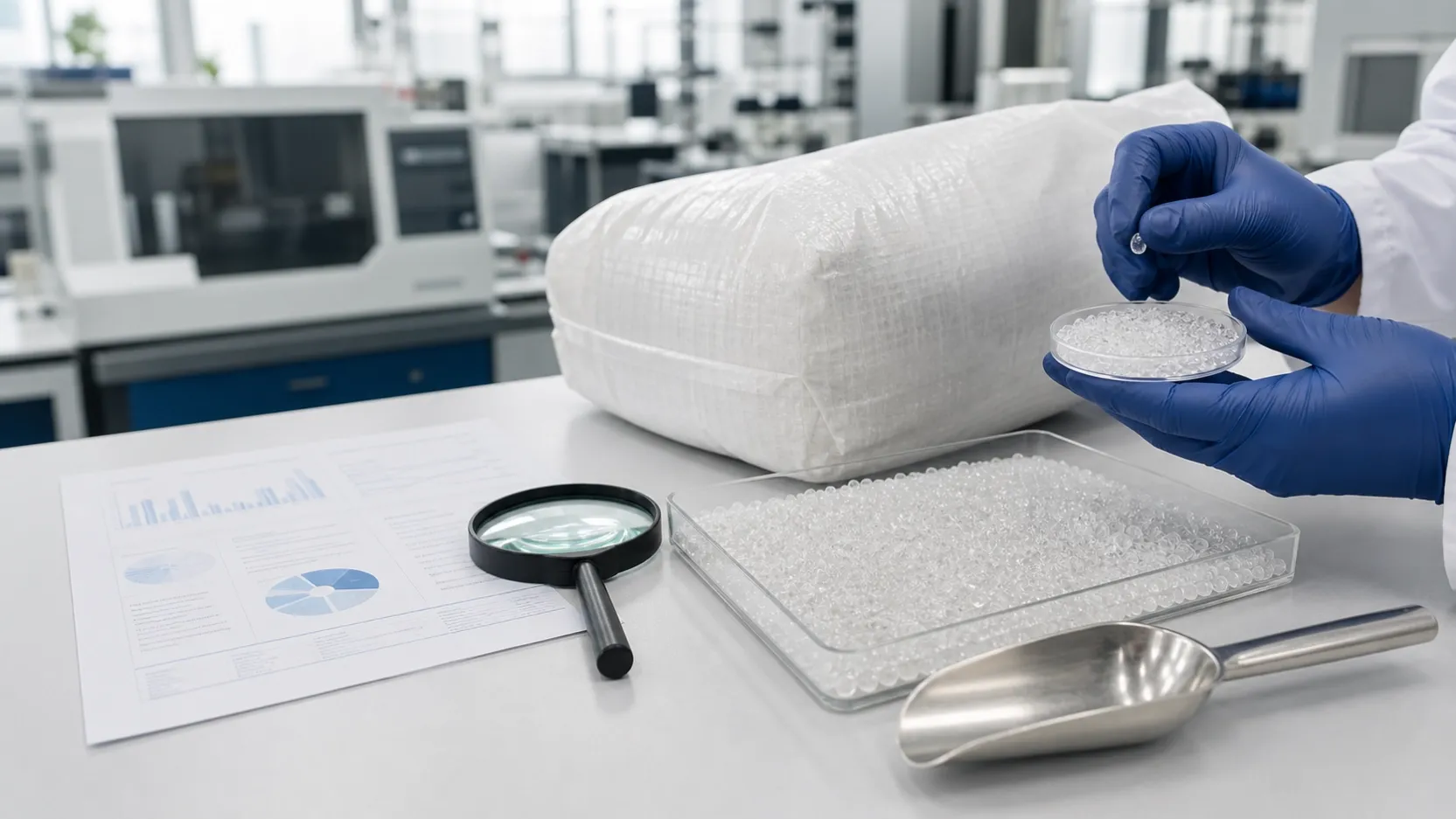
Open a bag and pour some pellets into your hand. Virgin resin pellets are uniform in size, shape, and color. Here is what recycled or mixed material looks like:
• Color variation: Virgin pellets should be consistent — translucent, natural, or uniformly colored. If you see dark specks, yellowing, or color streaking within the same bag, those are thermal degradation artifacts from previous processing cycles.
• Size inconsistency: Virgin pellets are cut to uniform dimensions (typically 2-4mm). If you see "fines" (dust), odd-shaped chunks, or pellets of noticeably different sizes mixed together, you're looking at regrind or a blend.
• Surface texture: Virgin pellets are smooth and glossy. Recycled pellets often have a rougher, matte surface from reprocessing.
• Foreign particles: Look for black specks (carbonized material from previous hot-runner degradation), metal flakes, or paper fibers. These come from contaminated recycling streams.
The Smell Test (Yes, Really)
This sounds unscientific, but experienced plant managers use it all the time. Open a fresh bag and smell the pellets.
• Virgin resin has almost no odor, or a very faint, clean "plastic" smell specific to the polymer type.
• Recycled material often carries residual odors: a burnt, acrid smell from thermal degradation; a sweet or sour smell from残留 additives breaking down; or even food/detergent odors if the recyclate came from post-consumer bottles or packaging.
If the bag smells like a chemical fire or a landfill, walk away.
Use a Laboratory Check for Final Acceptance
Visual checks can flag risk, but they cannot prove resin identity or virgin status. For a purchase decision, agree a test plan with a qualified laboratory. Depending on the grade and application, that may include identity screening, melt-flow testing, density, moisture, ash content, and mechanical-property comparison against the published TDS. Do not rely on improvised flame tests as an acceptance method.
Density Test: The Float/Sink Check
Different polymers have different densities, and contamination from a different resin type will show up here. This is especially useful for checking whether your "virgin" material contains mixed polymer contamination from a recycling stream.
Fill a beaker with water (density = 1.0 g/cm³). Drop in a handful of pellets:
• Different polymers behave differently in density testing: If a result is inconsistent with the specified resin, treat it as a reason for further laboratory identification rather than a final verdict.
• PC, PET, PMMA sink (density >1.0). If they all sink uniformly, that's consistent with what you'd expect.
For more precision, use a density gradient column (ASTM D1505), which can detect density variations as small as 0.001 g/cm³. If you're buying by the container-load, this test is worth the setup cost.
Mechanical Properties: When It Matters Most
If you have access to a small injection molder or test lab, mold a set of standard tensile bars (ASTM D638 Type I) and compare against the virgin grade's published datasheet:
• Tensile strength at yield: Compare molded specimens with the supplier's published test data using the same test method and conditioning requirements.
• Impact strength: This property is especially important for safety-critical or high-stress parts. Significant deviation from the agreed grade's TDS should trigger a material review.
• Elongation at break: A sensitive indicator. Virgin material stretches more before breaking. Recycled material tends to be more brittle.
If your molded parts show significant deviation from the datasheet across all three metrics, you're not holding virgin resin.
Gel Count and Contamination (Film/Fiber Grade)
If you're buying resin for film or fiber applications, gel count is the gold standard. Gels are small, cross-linked polymer particles that don't melt during processing and show up as "fish eyes" in film or weak points in fiber.
Agree the acceptable gel or contamination level before purchase, especially for appearance-critical film, fiber, optical, or medical applications. The limit should be application-specific and documented in the purchase specification.
Why Documentation and Traceability Matter
The apparent saving on resin can disappear quickly when a production run becomes unstable or finished parts have to be held for investigation. A documented approval process is usually less costly than discovering a mismatch after molding has started.
What a Reliable Supplier Looks Like
When sourcing virgin resin, especially from overseas, look for a supplier that provides:
• Batch-level TDS and COA with actual numerical data — not just "conforms to specification"
• Grade matching capability — they can source the exact manufacturer grade you need, not just "something similar"
• Traceability — lot numbers that trace back to the original polymerization batch
• Pre-shipment samples — a kilogram or two for you to test before the container ships
• Factory audit reports or third-party inspection — someone has actually visited the production line
Get in touch with our team if you need a supplier that checks all these boxes — we specialize in virgin-grade PET, PC, POM, EVA, PMMA, and ABS with full documentation and grade matching.
Frequently Asked Questions
Can you test plastic at home to see if it's virgin?
Without lab equipment, the most practical at-home checks are visual inspection (pellet uniformity, color, contamination), the burn test, and the density float/sink test. For anything beyond a preliminary screen, you need a lab.
Is virgin plastic stronger than recycled?
Yes, in virtually all cases. Each thermal-mechanical recycling cycle degrades the polymer chain length (molecular weight), which directly reduces tensile strength, impact resistance, and elongation. A single cycle might lose 5-15% of mechanical properties depending on the polymer and processing conditions.
How can you tell if PET is virgin?
Check intrinsic viscosity (IV) — this is the key quality indicator for PET. Virgin bottle-grade PET typically has IV around 0.80 dL/g. Recycled PET (rPET) will show lower IV values, and more importantly, wider IV variation within a batch. Also look for yellowing: virgin PET is crystal-clear; rPET often has a slight yellow tint from thermal degradation.
What is the price difference between virgin and recycled plastic resin?
Virgin and recycled resin pricing changes with polymer grade, region, feedstock markets, and demand. A price that is materially different from comparable offers should prompt a specification and documentation review before you buy.