Oct 9, 2026Material Guides
POM vs PA66: Which Engineering Plastic Is Better for Gears, Clips and Wear Parts?
Compare POM and PA66 for gears, clips, bushings and wear parts. Review friction, moisture, dimensional stability, strength and sourcing questions before selecting a grade.
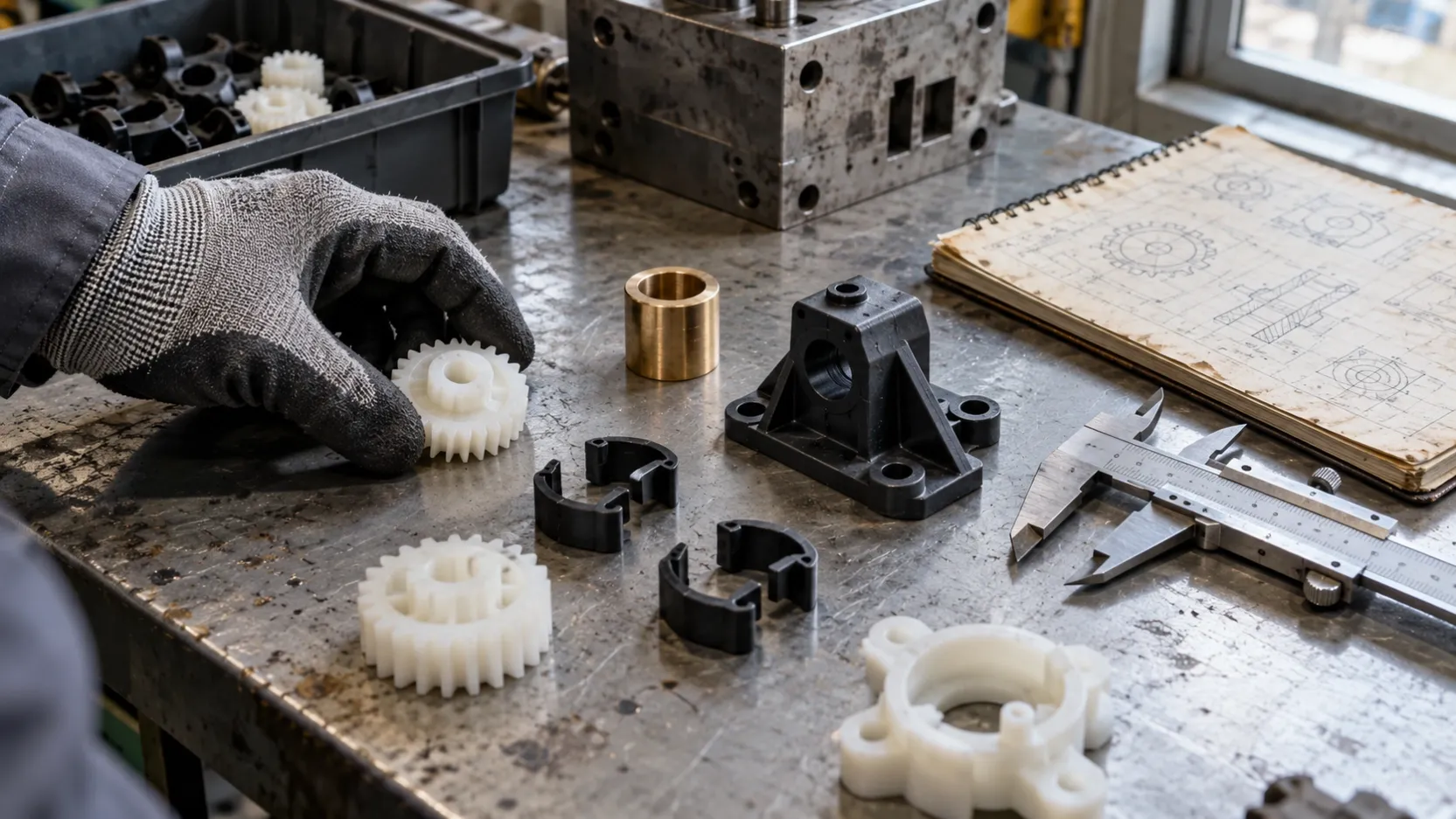
POM and PA66 are both widely considered for engineering parts, but they are not interchangeable. A gear, clip, bushing or moving assembly may look simple, yet the wrong resin choice can lead to excess wear, moisture-related dimensional changes, noise, stress cracking or costly tooling adjustments.
This guide helps buyers and processors compare POM and PA66 before selecting a grade.
The Quick Answer
Evaluate POM when low-friction movement, dimensional precision and repeated mechanical motion are major priorities.
Evaluate PA66 when the part requires a different balance of strength, temperature performance, toughness or reinforcement options.
The best material depends on the working environment, part design, mating material, loading cycle and processing method.
POM: Commonly Evaluated for Moving Precision Parts
POM is often reviewed for parts that slide, rotate, latch or require controlled dimensions.
Typical application directions include:
- Gears and gear housings
- Bushings and bearings
- Latches, clips and fasteners
- Pump and valve components
- Small precision mechanical parts
When reviewing a POM grade, buyers should check melt flow, tensile properties, impact performance, shrinkage, colour, lubrication needs and any exposure to chemicals or high temperatures.
PA66: Commonly Evaluated for Strength-Focused Components
PA66 is often considered for structural parts where mechanical loading, temperature exposure or reinforced grades may be relevant.
Typical evaluation directions include:
- Automotive clips and brackets
- Cable-management components
- Electrical and industrial parts
- Reinforced structural components
- Housings requiring a higher-strength material system
PA66 can behave differently depending on moisture condition, reinforcement level and the final operating environment. Compare like-for-like grades rather than comparing a general-purpose POM against a glass-fibre reinforced PA66.
POM vs PA66: A Practical Selection Table
Selection Question | POM | PA66 |
|---|---|---|
Moving or sliding part | Often evaluated first | Review when strength or temperature needs dominate |
Dimensional precision | Common consideration | Review moisture and conditioning effects carefully |
Reinforcement options | Grade-specific | Broad range of reinforced grades available |
Gear or bushing application | Common evaluation route | May suit selected load and temperature conditions |
Clip or bracket application | Can be suitable for precision latching | Often evaluated for structural clips and brackets |
Processing decision | Confirm shrinkage and mold design | Confirm drying, conditioning and reinforcement effects |
Five Questions to Ask Before You Choose
- Will the part slide, rotate or carry a constant load?
- What temperature and humidity will it experience?
- Is dimensional consistency more important than maximum strength?
- Does the part need reinforcement, colour matching or impact modification?
- What is the mating material: metal, plastic, rubber or another moving component?
Do Not Approve a Grade by Name Alone
“POM” and “PA66” describe material families, not identical products. Before purchasing, request:
- Current TDS, COA and SDS
- Exact grade and manufacturer identification
- Reinforcement or additive information
- Processing guidance
- Shrinkage and conditioning data
- A sample for production validation
Request an Engineering Plastic Review
Lema Plastic can help buyers compare POM and PA66 grades for gears, clips, bushings and precision components. Send your part drawing, process, operating environment, destination market and expected volume for a practical material review.