Aug 22, 2026Material Guides
Engineering Plastics Guide: PA, PC, ABS, POM & PBT Applications
Learn how to select engineering plastics including PA, PC, ABS, POM and PBT for automotive, electrical, industrial and consumer components.
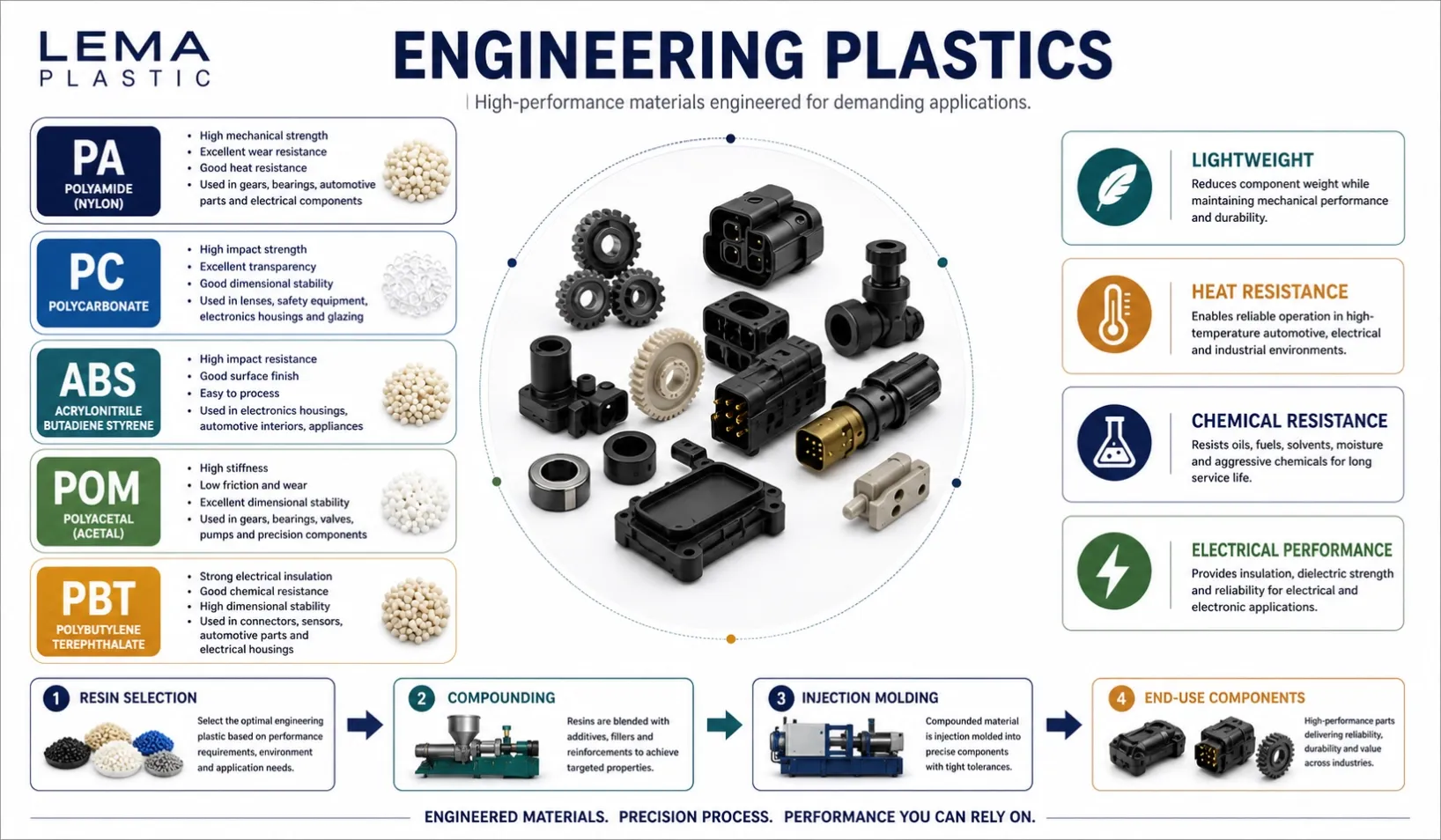
Engineering plastics are thermoplastic materials used when standard commodity plastics cannot provide enough strength, heat resistance, wear resistance, dimensional stability or electrical performance. They are widely used in automotive components, electrical connectors, industrial machinery, appliances and durable consumer products.
This guide explains how common engineering plastics—including PA, PC, ABS, POM and PBT—are selected for real manufacturing applications.
Why Material Selection Matters
Choosing the right engineering plastic affects more than the part itself. It can influence molding efficiency, product appearance, assembly cost, component life and long-term reliability.
A suitable resin must match the real service environment. For example, a plastic gear may need low friction and wear resistance, while an electrical connector may require insulation, dimensional stability and flame-retardant performance. Automotive under-the-hood parts may also need to withstand heat, vibration, oil and moisture.
Instead of choosing the “strongest” plastic, manufacturers should compare material properties against the part’s actual requirements.
Common Engineering Plastics and Their Applications
Polyamide: PA6 and PA66
Polyamide, also known as nylon, offers good mechanical strength, heat resistance and abrasion resistance. PA6 and PA66 are commonly used for brackets, clips, gears, bearings, air-intake parts, power-tool housings and electrical connectors.
Glass-fiber-reinforced PA grades can provide higher stiffness and better dimensional stability for demanding automotive and industrial components.
ABS: Balanced Strength and Surface Quality
ABS combines impact resistance, rigidity, easy processing and good surface appearance. It is a practical choice for appliance housings, consumer products, automotive interior trim, air-vent surrounds and electronic enclosures.
ABS is often selected when both appearance and durability matter in injection-molded parts.
PC and PC/ABS: Impact Resistance for Durable Housings
Polycarbonate offers high impact resistance, heat resistance and transparency. It is used in safety equipment, lighting components, lenses, covers and electrical housings.
PC/ABS combines the toughness of PC with the processing performance and surface quality of ABS. It is frequently used for center consoles, instrument-panel trim, electrical enclosures and durable consumer-product housings.
POM: Low Friction for Precision Components
Polyoxymethylene, also called acetal or POM, is valued for its low friction, wear resistance and dimensional stability. It is suitable for precision gears, bearings, valves, pump components, clips and other mechanical parts with moving surfaces.
POM is often considered when a component needs accurate dimensions and reliable repeated movement.
PBT: Electrical Insulation and Dimensional Stability
Polybutylene terephthalate, or PBT, provides good electrical insulation, chemical resistance and dimensional stability. It is commonly used in electrical connectors, switches, sensors, relay components and automotive electrical systems.
Modified or reinforced PBT grades may be considered when higher heat resistance, stiffness or flame-retardant performance is required.
How to Choose an Engineering Plastic
Before selecting a material, define the component’s real operating conditions:
- Operating temperature and heat-aging requirements
- Impact strength, stiffness and load-bearing needs
- Exposure to oils, fuels, cleaning agents, moisture or UV
- Electrical insulation, CTI or flame-retardant requirements
- Surface appearance, color and texture requirements
- Injection molding process, wall thickness and part geometry
- Dimensional tolerance and long-term stability needs
A material with strong data-sheet properties may still underperform if the grade, drying conditions, mold design or processing parameters are not appropriate.
Typical Engineering Plastic Applications
Engineering plastics are used across multiple industries:
- Automotive: Interior trim, brackets, air-intake parts, electrical connectors, battery-related components and under-the-hood parts
- Electrical and electronics: Connectors, switch housings, sensors, cable-management parts and control enclosures
- Industrial machinery: Gears, bearings, valves, pump components and wear-resistant mechanical parts
- Appliances and consumer goods: Durable housings, functional components, handles and structural parts
- Construction and equipment: Electrical accessories, fittings, tool components and equipment housings
Modified Engineering Plastics for Higher Requirements
When standard resin performance is not sufficient, modified engineering plastics can be developed with glass fiber, carbon fiber, flame retardants, impact modifiers or other additives.
Modified PA compounds are commonly used where higher stiffness, heat resistance, flame resistance or electrical performance is required, especially for automotive, EV and electrical applications.
Discuss Your Engineering Plastic Requirements
The right engineering plastic depends on the part design, processing method and target performance—not only on the material name. LEMA PLASTIC supports buyers with engineering plastics and modified compounds for automotive, electrical, industrial and consumer applications.
Contact us to discuss your material requirements, request technical information or identify a suitable resin grade for your next project.